Pratap Singh Introduction Letter Draft
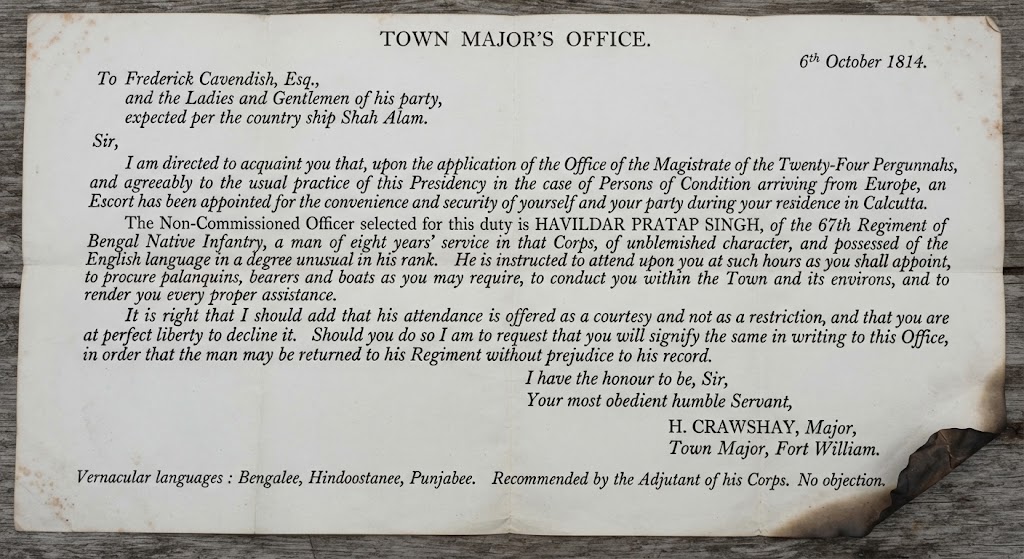
Content
TOWN MAJOR’S OFFICE FORT WILLIAM 6th October 1814
To Frederick Cavendish, Esq., and the Ladies and Gentlemen of his party, expected per the country ship Shah Alam.
Sir,
I am directed to acquaint you that, upon the application of the Office of the Magistrate of the Twenty-Four Pergunnahs, and agreeably to the usual practice of this Presidency in the case of Persons of Condition arriving from Europe, an Escort has been appointed for the convenience and security of yourself and your party during your residence in Calcutta.
The Non-Commissioned Officer selected for this duty is HAVILDAR PRATAP SINGH, of the 67th Regiment of Bengal Native Infantry, a man of eight years’ service in that Corps, of unblemished character, and possessed of the English language in a degree unusual in his rank. He is instructed to attend upon you at such hours as you shall appoint, to procure palanquins, bearers and boats as you may require, to conduct you within the Town and its environs, and to render you every proper assistance.
It is right that I should add that his attendance is offered as a courtesy and not as a restriction, and that you are at perfect liberty to decline it. Should you do so I am to request that you will signify the same in writing to this Office, in order that the man may be returned to his Regiment without prejudice to his record.
I have the honour to be, Sir,
Your most obedient humble Servant,
H. CRAWSHAY, Major, Town Major, Fort William.
In a second and smaller hand, at the foot:
Vernacular languages: Bengalee, Hindoostanee, Punjabee. Recommended by the Adjutant of his Corps. No objection.
Context
Presented by Havildar Pratap Singh himself on the landing steps at Chandpal Ghat, in the rain, within minutes of Holt’s farewell — see Scene 02 Chandpal Ghat.
The letter is entirely genuine. It was issued by the Town Major’s office, on a real application from the Magistrate’s office, under a real and ordinary Presidency practice. Nobody who signed it, filed it or carried it has done anything improper.
Clues Embedded
Prop Notes
Single sheet, folded in three, carried inside a coat against the rain and therefore slightly damp at one corner. Official hand — a clerk’s copperplate, not the Major’s own — with the signature in a different and heavier ink. The havildar’s name in the body should be conspicuously larger or capitalised, as it would be in a real assignment order.
If printing it: the date at the top right is the whole prop. Do not draw attention to it in the layout. Set it exactly as small as the rest.
Printable prop (preferred): Chapters/Chapter 4 - Calcutta/Props/pratap-introduction-letter.html — open in a browser, print with Background graphics on, margins None. Text is verbatim from this file; the image prompt below remains as an alternative.
Atomic image prompt
Create an image. Canticle of the End: Regency era, 1814-15. Palette of deep amber, tarnished gold, bone white and shadow black. Period light sources only - grey daylight. No modern elements. Aged paper with iron gall ink in an official clerk's copperplate, an office letterhead, foxing and water damage at the edges. The horror is implication and absence - wrongness in a detail noticed second, nothing overt.

A single sheet of good 1814 official letter paper, laid flat, folded in three with the creases sharp and one corner darkened and cockled by rain. A short military office heading in engraved capitals at the top, a date at the top right, and eight lines of formal body text in a uniform clerk's copperplate. One name in the third paragraph set in noticeably larger capitals. A signature at the foot in heavier, blacker ink than the body. Two lines of smaller, cramped writing added at the very bottom in a different hand. Flat grey daylight, no shadows.
Relationships
- Concerns Havildar Pratap Singh — The letter that places him with the party. Genuine, official, and arranged.
- Originates from Fort William — Issued by the Town Major's office
- Concerns Charles Ashworth — Cited as the requesting authority — and he did request it, routinely, knowing nothing