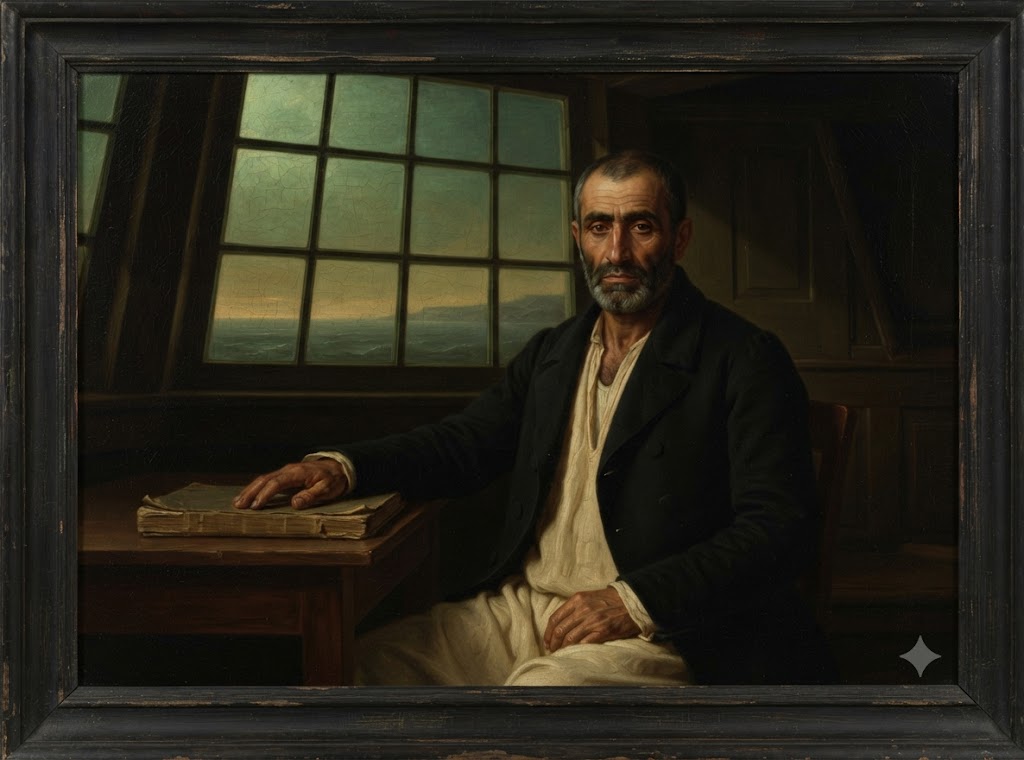
Description
Fifty-six, Armenian, Calcutta-born. Not a large man, and entirely unbothered by that. He wears European coat and Indian cotton in whatever combination the weather argues for, and he has the flat, patient stillness of someone who has spent forty years waiting on winds that do not care about him.
He speaks Armenian, Bengali, Hindustani, Persian, Arabic, and an unhurried, precise English with the Calcutta rhythm under it. He states terms once. He does not haggle, and he is visibly unentertained by anyone who tries.
Voice note: courteous and entirely unimpressed. He has carried nabobs and he has carried pilgrims and he charged both, and nothing in a passenger’s manner has ever once changed his price.
Background
Born into Calcutta’s Armenian community, which has been established in Bengal since long before the East India Company mattered there — the Church of Holy Nazareth on Armenian Street dates to 1707. He is a country trader: privately owned, Indian-built shipping working outside the Company’s monopoly, running the Red Sea coffee season up to Mocha and Jeddah and home to Bengal on the turn of the monsoon.
He has never worked for the Company and enjoys saying so, in the mild way of a man who considers it simply a fact about himself rather than a position he is defending.
Motivations
- The cabin money. Eight passages is real income and he wants it.
- A clean run home before the season closes. He will sail on the monsoon’s tail whether or not anyone is aboard, and he says so plainly at the charter. There is no negotiation about when.
- No trouble in his ship. He is not curious about his passengers and would prefer to stay that way.
As Played — Session 7
He brought the Shah Alam into Suez at dawn and was standing at the gangplank watching his crew tie up when Adrien, Holt and Ashby reached him — a column of Ottoman soldiers marching for the same berth a few minutes behind them. He spoke English, he was open to negotiation, and the whole thing was settled in one short exchange: one hundred pounds for eight passages to Calcutta, the passengers sharing the ship’s cabin, the captain keeping his cargo of coffee and hides. A Board of Control man among the passengers was enough to discourage the soldiers from pressing their claim.
At Socotra he did not refuse the rescue. When Georgiana and Ashby reported the boy missing, he was unimpressed — assumed Jumman had wandered off following a coloured bird — but he sent a lookout to the crow’s nest, and when the search became a rescue he made no objection to his crew’s ladders, rigging and torches going into the cliffs. The party never had to argue with him.
Connections
- Master of the Shah Alam; his working chain of command runs through Serang Ismail and never around him.
- Belongs to the same continent-spanning Armenian merchant network as Krikor Bedrossian in Cairo — invoking Bedrossian’s name opens the charter in a single conversation.
- He is the party’s introduction to Calcutta’s Armenian community before they ever see the city — a friendly door in Bengal that owes the East India Company nothing.
Appearances
Relationships
- Located at Shah Alam — Aboard for the Suez → Calcutta passage
- Commands Shah Alam — Master and part-owner; the ship is his living and his season
- Employs Serang Ismail — Gives every order to Ismail and never to the men directly
- Allied with Krikor Bedrossian — Same Armenian trading network, Egypt to Bengal; the name opens the charter
- Trades with Freddy Cavendish — Chartered the party's passage to Calcutta for one hundred pounds at the Suez gangplank
- Knows Socotra — Has watered in the sheltered bay before on the Mocha run without trouble