The works come as noise first: mattocks, the suck and clank of a hand-pump, a sergeant counting in Hindoostani.
Description
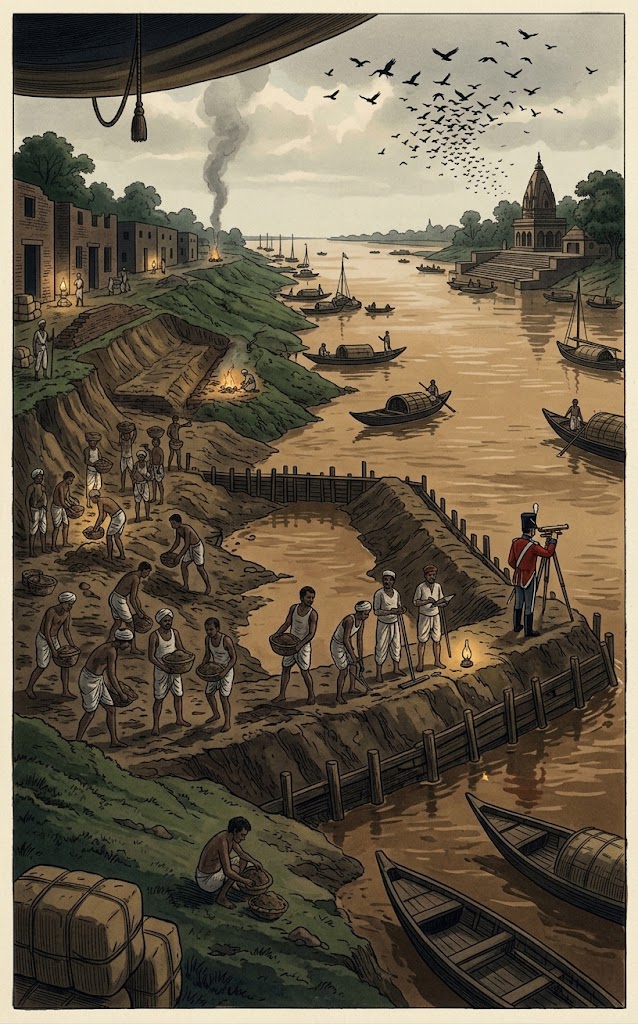
The works come as noise first: mattocks, the suck and clank of a hand-pump, a sergeant counting in Hindoostani. Then the western bank opens in a raw brown cut, and a dam of piled earth and timber runs out into the stream with a line of men carrying baskets of mud up its back. Behind the piling the water lies flat and still, and country boats ride on it, tied to stakes.
A Bengal Engineers detachment under Major Edward Renwick has been reinforcing this stretch of bank for eight months, where the monsoon undercut it at the bend opposite Baranagar. It is flood prevention, and it is legitimate work.
What’s Here
- The cofferdam: a half-built wall of driven timber piles packed with earth, running out into the river from the downstream end of the cut. Its top is wide enough to walk on, and Renwick stands on it to sight down the river with his level. Anyone on top has the whole reach of river in view, east bank included.
- The slack water: the still pool between the piling and the bank. Hired boats and the works’ own boats tie up here, and the boatmen call the dam “Renwick-sahib’s wall”. This is where a boat from Calcutta lands.
- The cut: a raw face of brown clay where the bank has been dug back to sound ground, stepped and shored with timber. The new embankment rises behind it in packed layers, each beaten flat by men with wooden rammers.
- The basket lines: about sixty labourers carry mud in head-baskets from the cut to the embankment and back, in two endless files. A native overseer runs the gangs; a British sergeant counts the loads.
- The hand-pump: a wooden pump on the inside of the cofferdam, worked by two men at a time, lifting seepage over the wall. It clanks without stopping while the works are running.
- The sappers’ tents: a short row of canvas tents on higher ground behind the cut, for the handful of British sappers and the Company’s sepoy and pioneer party.
- The powder magazine: a small, earth-banked hut sunk into the higher ground, well apart from the tents, with a stout door and a padlock. Renwick says it holds sixty barrels.
- Renwick’s survey tent: a larger tent with the flaps tied up, a trestle table, a surveyor’s level in its box, the cofferdam drawings weighted down with stones, soundings of this reach of river in his own hand, and his site notebook.
History
- The works have been running for eight months, since early 1814.
- Renwick knows every current, depth and channel of this stretch of the Hooghly from building in it.
- A warning order reached the works on Monday 10 October: when the work is finished, Renwick goes to the Nepal column, target 1 November. Freddy had him struck off the draft at Fort William on Thursday 13 October.
- The Fort William records place the works “eight miles north of Calcutta at Baranagar” (Renwick Located at Baranagar).
Related
- People: Edward Renwick: commands the works
- People: James Hatcherly: Renwick’s sapper lieutenant, holds the magazine keys
- Places: Baranagar: the village opposite, across the river
- Places: Mandir Mahakali: on the east bank, a little upstream, within earshot
- Places: Fort William: the garrison the detachment answers to
Campaign Log
- Session 15 - The River of Rites and Ruin — the upriver party landed behind the cofferdam, toured the earthworks with Renwick and took tea before crossing to Baranagar.
Connections
Places
Borders
- Baranagar Location hostileFaces the village across the river; the temple stands on the east bank a little upstream1 session: The River of Rites and Ruin
Located at
- The Hooghly River Location neutralOn the western bank, where the river bends opposite Baranagar
Part of
- The Hooghly River Location