Calcutta — The Cycle of Dissolution
The River of Rites and Ruin
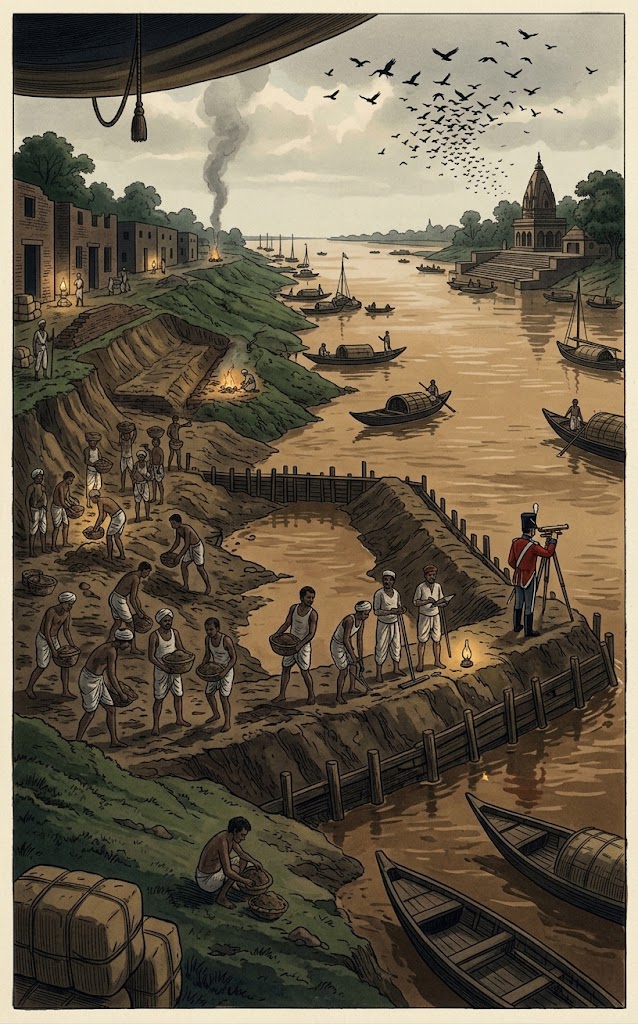
The river party’s boat slid out of the current and into still water behind a wall of driven timber, the hum in the planks falling silent as they arrived at the cofferdam construction site. Up on the bank, two files of men carried baskets of wet clay between a raw brown cut and a rising embankment, while a hand pump clanked without pause. A lean officer in shirtsleeves strode along the top of the dam toward the landing, a brass surveyor’s level tucked under one arm and ink staining his fingers — Major Renwick, the man overseeing the whole ambitious enterprise.
Renwick greeted the party warmly, surprised but pleased to see them so far upriver, and offered a brief tour of the earthworks before settling them at a camp table with tea and unleavened bread. He introduced Lieutenant Hatcherly of the Bengal Engineers, a young and handsome officer visibly frustrated by the unexplained replacement of half the labor force with no reason given. As the group took in the view across the river — the village of Baranagar and the temple with its two prominent ghats facing the water — a nervous young sepoy quietly approached Pratap Singh, asking for a private word and a moment of his time before the party departed. The group thanked Renwick for his hospitality and boarded their boat once more, crossing the river toward the village.
Back in Calcutta, Katherine Ward and Freddy Cavendish were taking stock of the compound’s defenses — a handful of teenage street toughs patrolling the grounds and two sepoys left behind by Pratap Singh. Katherine had already been recruited by Anne Pelham to break into the Surlish estate near Clive Street and retrieve compromising legal documents, and the two of them were quietly working out how their separate missions might align. First, however, there was the matter of Meg Cavendish, who needed to be spoken to.
Katherine found Meg in the nursery, surrounded by six maidservants armed with knives and short sticks, tending to little two-year-old Freddy. Katherine attempted to explain the danger the party had brought to the household — the musical cults, the fantastical horrors, the destroyed coach — but Meg was immovable, resentful, and utterly unwilling to be chased from her own home. When Freddy joined them, he suggested at minimum creating a fortified safe room within the house, and Meg conceded that such preparations were already underway. The group agreed that visiting Sophia Surlish the following morning, without her husband’s interference, would be their best next move, and Meg agreed to send a letter arranging it.
Across the river, the party arrived at the village of Baranagar as the afternoon light began to soften toward dusk. The village smelled of wood smoke, marigolds, and river silt, its single bazaar lane lined with raised shop fronts selling cloth, brass, sweets, and garlands threaded for the temple. Emma and Georgiana were drawn to a weaver’s stall displaying extraordinary shawls — cotton and wool in deep greens, blues, vibrant reds, and indigo purples — and purchased several, including one woven with the image of a tiger in the jungle, before the group made their way north toward the temple and the house of their host.
Acharya Devendra Ghosh’s home stood a little back from the temple ghat, a two-story lime-washed brick house wrapped in pillared verandas and lit warmly from within. A servant welcomed them into a paved courtyard with a household shrine, a Tulsi plant on a plinth, and lamps being lit in niches around the walls, and explained that the Acharya was currently performing the evening arti at the temple next door. Servants brought out sweetmeats and tea while the party waited, and before long Ghosh himself appeared — a charming elder Indian gentleman who accepted Charles Ashworth’s letter of introduction with warmth and immediately set about arranging rooms and dinner for his guests. Thomas Wyndham and Pratap Singh were shown to a shared room, where Thomas produced a flask of French brandy and the two men shared a quiet drink, while Emma, Georgiana, and Elizabeth Ashby were given a room of their own, where they quietly armed themselves and warned Elizabeth to stay alert.
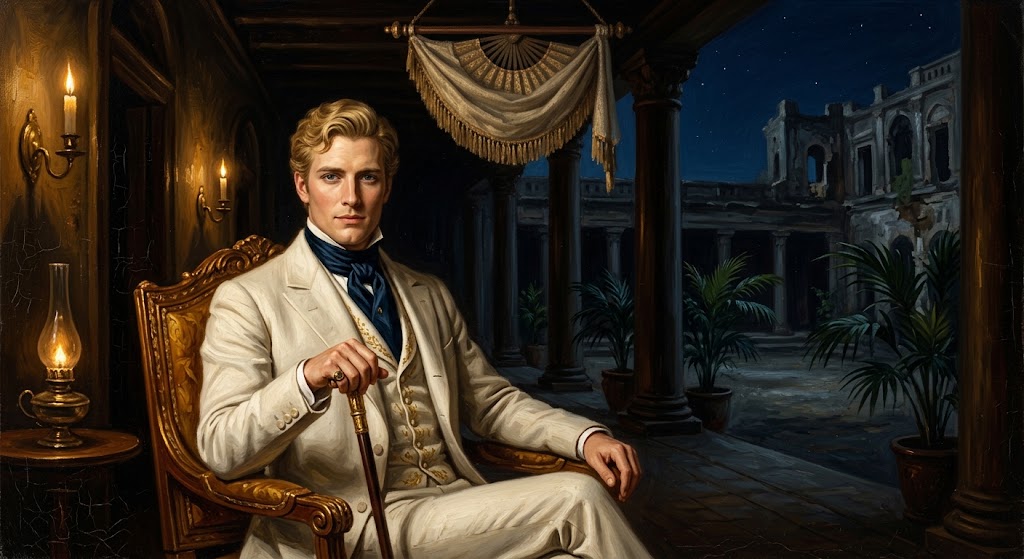
Dinner was laid out on the bottom veranda overlooking the river, a humble spread served by a wall of attentive servants, and Ghosh took his place at the head of the table with easy charm. Then he announced a second guest — and through the door walked Baron Otto von Kaunitz, smug and self-satisfied, taking the empty chair at the head of the table as though he owned it. He gloated about his return to power and his new associations, referencing the party’s interference in Vienna, while Ghosh watched him from the side with barely concealed contempt.
What followed was something none of them would ever fully recover from. Ghosh dropped his hospitable facade and revealed the true scope of his cult’s reach — every rung of the British government, the East India Company, the military, the judiciary, all of it infiltrated. He declared that what was going to happen was preordained, that the ritual on the night of Kali would open a gate for the elder god Yog-Sothoth, and that the party had wandered into the heart of it with blind, white arrogance. Then he clicked his fingers, and the servants closed in.
The party was seized and held in their chairs as a rhythmic chanting began to fill the veranda. The four servants holding the Baron began to change — their flesh softening, running, flowing together and into him like cream stirred into a curry, multiple bodies merging into a single slow, luminous mass of shared skin and smeared clothing. The Baron’s face was the last of him to go under, and in the moment before it did, the terror left it entirely. When the mass drew apart again, the Baron was left sitting in his chair, physically distorted — his eyes no longer aligned, his dimensions subtly wrong — and utterly broken, a meek and compliant shell who murmured that he had seen everything and been part of something greater.
Georgiana, her hand tingling and pulsing in response to the chanting, made a decision. She unwrapped the silk scarf and brooch she had used to conceal her transformation and laid her hand bare on the table — webbed fingers, scaled skin creeping toward the forearm, a middle finger with a displaced knuckle that no longer lined up with the rest. Ghosh regarded it with interest and then dropped his own robes to reveal his arm, which from the elbow down had become a sinuous tentacle with sprouting fronds where fingers had once been. He told her she was achieving Samapti — becoming one with the universe — and invited her to join them. Then he rose, collected the broken Baron, and left the party to their dinner, dismissing them as not worth the trouble of killing.
Elizabeth Ashby was found staring fixedly at the middle of the table, white-faced and shaking, and had to be physically guided to her feet. The group gathered their belongings without ceremony and fled into the dark village streets, making their way by lantern light to the Dak Bungalow — a small East India Company rest house on the Chitpur Road. Two company servants stoked the fire and made up the bunk beds while Thomas surrendered his carefully hoarded brandy to steady everyone’s nerves, and the party settled in for a tense and sleepless night.
Back at the Cavendish compound, the evening had taken an unexpected turn when Hugh arrived home not alone but accompanied by Hawthorne Surlish and his wife Sophia, carried in a palanquin. Dinner was a stilted and unpleasant affair, with Surlish sneering at the hospitality and insulting Hugh’s compound and business acumen at every turn, while Sophia quietly tried to smooth things over and was glared into silence for her trouble. Freddy, sensing an opportunity, bribed a servant handsomely to procure the finest alcohol available, and a bottle of twenty-five-year-old single malt Scotch appeared just as the men retired to discuss business — drawing a rare expression of approval from Surlish and buying precious time.
With the men occupied, Katherine slipped away unnoticed, took a palanquin to Clive Street, and found the servant’s gate at the back of the Surlish estate unlocked. She crossed the yard in the dark, but her toe caught something that skittered and clanged across the mud, and two servants emerged from their quarters with candles, following her footprints. She dove into the stables and buried herself in hay, waiting in silence until the servants gave up and returned to bed. Then she crossed the yard again, scaled the outside stairs to the upper veranda, picked the lock to Hawthorne’s private study, and searched the room — emerging with his calf-bound pocketbook, full of cryptic entries about Tuesdays and spoilage with one page already torn out, and a docket of seven legal petitions tied with red tape, exactly what Anne Pelham had sent her to find.
Meanwhile, Freddy had drawn Sophia into conversation, and what she revealed was deeply unsettling. She described her husband’s weekly Tuesday night excursions, returning at dawn smelling of river mud and sandalwood with shirts stiff with a pale, shimmering substance. She had once followed him to the river and watched him stand over a laborer whose arm hung from a charpoy like wax held too near a candle, timing the transformation with his pocket watch open, the word spoilage noted in his private book afterward. She confessed that Hawthorne intended to take her upriver to Baranagar for Ghosh’s festival on the twenty-fifth, and that she feared what he had planned for her there. Meg immediately offered her sanctuary at the compound, and Sophia accepted — and when she asked who would be the one to tell Hawthorne, Freddy’s smile was answer enough.
The confrontation came swiftly. Surlish stormed out of Hugh’s study threatening to cancel his syndicate and ruin him entirely, then moved to collect Sophia and leave. Sophia refused to go. Freddy drew his blade to block the way, but Surlish knocked it aside with the flat of his hand and challenged him to meet at dawn on the Maidan. It was at that precise moment that Katherine’s palanquin arrived back at the compound gates — and from somewhere above, two heavy thumps landed on the roof in the dark, and the night held its breath.