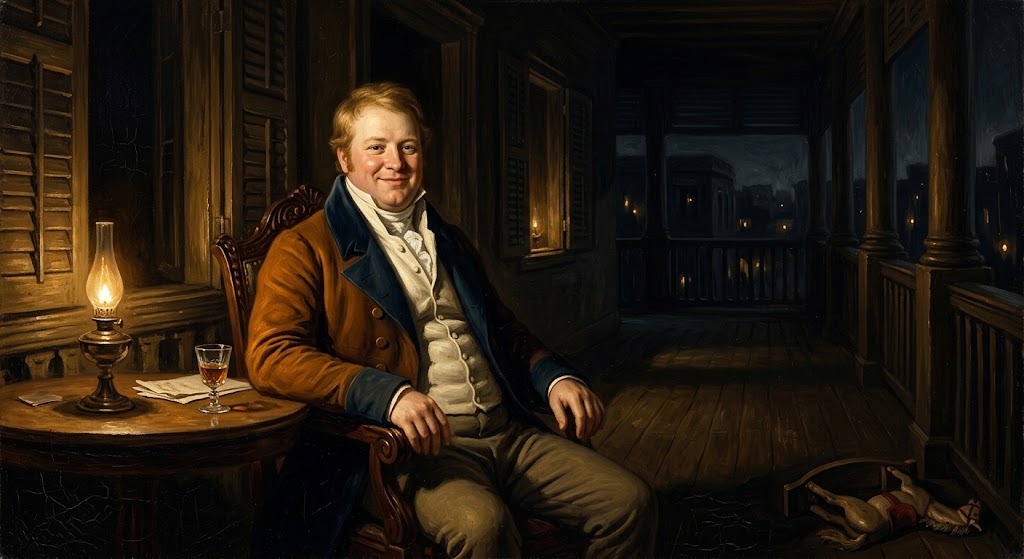
Description
Twenty-seven. Eleven years in Bengal (went out at sixteen as a writer). The warmth Freddy performs, Hugh means. He actually likes people: his servants, his colleagues, the Indian merchants he trades with. Learned enough Bengali to be conversational, which his superiors consider eccentric and his servants consider respectful. Runs his operation honestly in a system that doesn’t require honesty.
Content. Not ambitious the way Calcutta rewards ambition. He wants to run his operation well, raise his children, and have people to dinner. A man who found his life early and settled into it. The cousin’s charm is genuine but less strategic than Freddy’s. He assumes good faith because he operates in good faith, and it keeps costing him.
Background
Senior EIC factor in the opium division, overseeing river transport from Bihar production regions through to the Calcutta auction houses. The trade is legal, official, enormously profitable, and morally complex only if you step far enough back to see the whole picture. Hugh doesn’t see himself as doing anything wrong because nobody in Calcutta in 1814 does.
Hugh named his son after Freddy. That tells you everything about how he feels about his cousin.
The Squeeze
This is Hugh’s problem, stated plainly, because it is easy to lose in the warmth of the man.
The chokepoint
Hugh runs river transport: opium from the Bihar production regions, down the Ganges and the Hooghly, into Calcutta. That is his half of the pipeline and he is good at it.
He does not own a warehouse. Company opium must be landed, graded, weighed and stored before it goes to the auction rooms, and the godowns on The Strand that do that work belong to the free merchants. Surlish controls the ones Hugh uses.
So Hugh’s entire operation passes through a building owned by another man. That is the whole of it. Surlish does not need to do anything dramatic. He only needs to be slow.
How the squeeze actually works
- The storage contract has been renegotiated three times in four years, worse each time. Higher rates, shorter terms, and a clause about demurrage that Hugh signed because the alternative was no warehouse at all.
- A consignment held two weeks misses an auction. Not lost, not damaged, simply late, with an apology and a reason. Hugh’s tonnage then lands in the following quarter’s numbers.
- Numbers are how the Company measures a factor. Three quarters of consignments arriving late is not a scandal. It is a man who is losing his grip, and it is the sort of thing that gets written in a minute somewhere in the Writers Building.
- There is nowhere else to go. The merchant houses agree their rates among themselves and the Company ratifies it afterwards. The consortium is the market. Hugh moving his business is not a negotiation, it is an announcement, and the other houses would quote him the same terms within a week.
- And now it has an edge on it, because of the discrepancy.
The discrepancy
Inventory that does not reconcile between what Hugh’s boats deliver and what Surlish’s tallies record. Small amounts. Consistent. Every month.
Hugh noticed because Hugh is careful. He raised it with Surlish, twice, politely, as a housekeeping matter. He was told to stop asking, the second time in a way that was not polite, and the contract got worse at the next renewal.
What Hugh thinks it is: pilferage, or a dishonest godown clerk, or sloppiness. He finds it professionally offensive rather than sinister. He is a man who cannot stand a set of books that does not balance.
What he stands to lose
Not his life. His life’s work, which at twenty-seven is eleven years long and is the only thing he has ever built.
The position. The compound, the establishment, the twenty-two people it employs, the standing that lets him have people to dinner. Meg is five months pregnant and the baby comes in February. He has one child already, named after a cousin he has not seen in eleven years.
He has not told Meg how bad the contract is. She has worked most of it out anyway, from the household accounts, and has not told him she knows.
Why he cannot fight it
- He has no instinct for social combat. Freddy would have seen this coming in the first quarter and had three answers ready. Hugh assumed good faith, because he operates in good faith, and it has cost him every single time.
- Going above Surlish means going to the consortium, and the consortium is Surlish’s world.
- Going to the Company means opening his own numbers, which is the thing he is trying to avoid.
- Going to Ashworth means nothing. A hard bargain is not a crime. The Magistrate would be sympathetic and would be able to do precisely nothing, and Hugh knows it and has not bothered.
So he absorbs it, and he is cheerful about it, and he has been for four years.
The shape of the decline
| When | What happened |
|---|---|
| 1810 | First storage contract with Surlish’s house. Ordinary terms |
| 1811 | Renegotiated. Rates up. Hugh signs, mildly annoyed |
| 1812 | Hugh first notices the tallies not reconciling. Mentions it. Nothing happens |
| 1813 | Renegotiated again, worse. Raises the discrepancy a second time and is told to drop it |
| Early 1814 | Two consignments held. Both miss auction. First quarter he has ever had to explain |
| October 1814 | Contract due for renewal in the new year. He does not know what he will do |
Motivations
Protect his family. Run his operation honestly. Be a good host to his cousin. He does not understand the forces bearing down on him from both sides: Surlish’s commercial squeeze and the cult infrastructure his trade unwittingly supports.
Connections
- Freddy Cavendish — First cousin, namesake of Hugh’s son
- Margaret Cavendish — Wife
- Hawthorne Surlish — Controls his warehouse access, professional antagonist
- Charles Ashworth — Magistrate who oversees Hugh’s district
- Baijnath Mullick — Merchant patron in Hugh’s commercial network
In Play
Chapter 4, Session 8 — the party arrives (8 October 1814). Hugh came out to meet them himself at the compound and read, to the party’s eyes, as a slightly older and slightly heavier Freddy. He presented Meg, five months pregnant, and little Freddy, who was sick down his namesake’s suit within a minute of meeting him. He housed the whole party — women in the West House, men in the East, Pratap Singh in a cabin by the stables — over Mulligatawny soup.
Asked about the estate, he answered “as long as it may last,” and then gave the party the squeeze in full: Surlish owns the godowns on The Strand that all his opium must pass through, the storage contract has been renegotiated at worse terms each time, and consignments are held until they miss auction and land in the wrong quarter’s numbers. He described the contract and the delays. He did not mention the discrepancy in the tallies — the thread that actually leads anywhere is still unspoken.
Chapter 4, Session 9 (9 October 1814) — he asked his cousin the direct question. He sat with the party at St John’s and afterwards, back at the compound, pulled Freddy aside for a drink to ask what he had said to Surlish, and what he is actually doing in India.
He attended the Magistrate’s dinner at Garden Reach, out of his depth and enjoying it. His tally discrepancy remains unspoken, and Surlish spent the day telling Freddy to audit him.
Appearances
Relationships
- Located at Calcutta 1814 — Resident in Calcutta
- Sibling of Freddy Cavendish — First cousins. Hugh named his son after Freddy.
- Spouse of Margaret Cavendish — Deeply in love. Hugh married a woman who argued with him about river navigation on their third meeting.
- Serves Hawthorne Surlish — Surlish controls the warehouse side of Hugh's trade. Professional squeeze disguised as business.
- Parent of Frederick Cavendish the Younger — His two-year-old son, named for the cousin he had not seen in eleven years
- Family of Lord William Cavendish — His uncle and patron. One nomination at sixteen made Hugh's whole life, and Hugh knows exactly how little thought it took