Calcutta — The Cycle of Dissolution
The Third Course
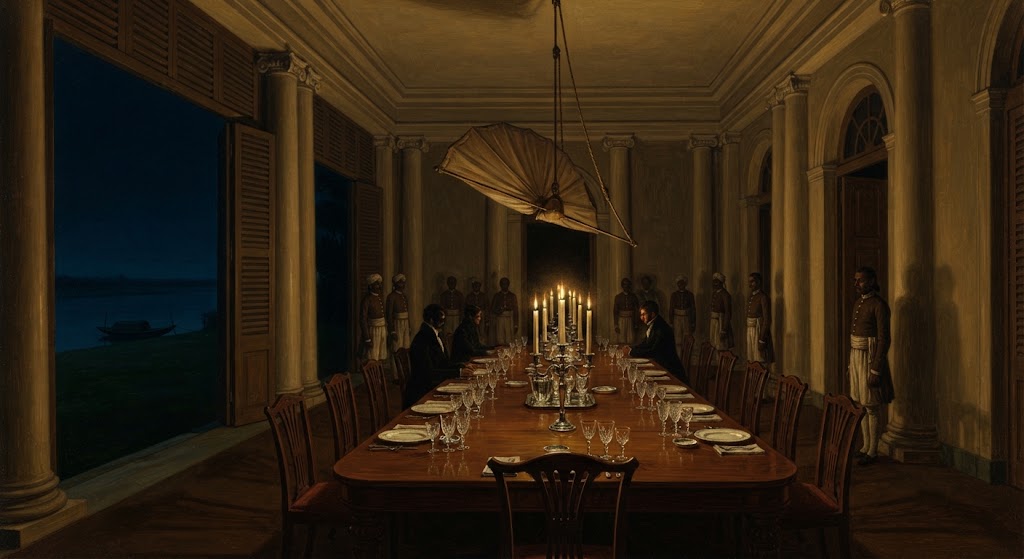
The evening at Magistrate Ashworth’s estate began with all the grandeur Calcutta’s colonial society could muster — exotic fruits arranged on silver, candelabras doubled in the dark mahogany of the table, and the slow beat of the punkah fan overhead keeping time with the distant sounds of river traffic. But away from the glittering table, in the servants’ quarters, a far less elegant scene was unfolding. Two of the house servants dragged Ratan, the Pelhams’ palanquin driver, before Havildar Pratap Singh, a fistful of silver spoons bearing Magistrate Ashworth’s crest pulled from the man’s waistband. Ratan’s defense was as implausible as it was desperate — he claimed he had simply fallen and the spoons had somehow landed in his cummerbund — before breaking down entirely and confessing that the Pelhams were cruel employers who burned the petitions of the local people rather than addressing them. Pratap Singh, weighing the political sensitivities of the moment, ordered Ratan beaten within an inch of his life and sent back to his palanquin, a decision that left the man firmly in the Havildar’s debt and the Pelhams’ household secrets potentially within reach.
Back at the dinner table, the conversation moved through the full range of colonial preoccupations. Magistrate Ashworth extended an invitation to a tiger hunt the following Saturday, cheerfully noting that a wall of sepoys would stand between the party and the animal. Captain Hale, who had been drinking steadily and silently all evening, suddenly spoke up as the conversation turned to the temple at Baranagar, describing flickering lights, strange colors, and chanting that he had observed during his night patrols — running from ten in the evening until six in the morning — almost every time he passed. He offered no theory, only a grunt and a return to his drink, leaving the table to draw its own conclusions about what dedicated worshippers might be doing through the small hours of the night.
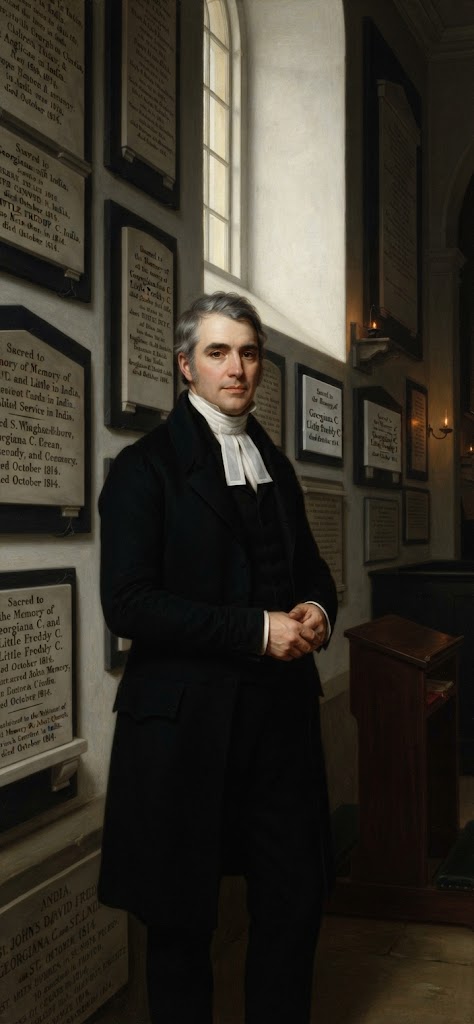
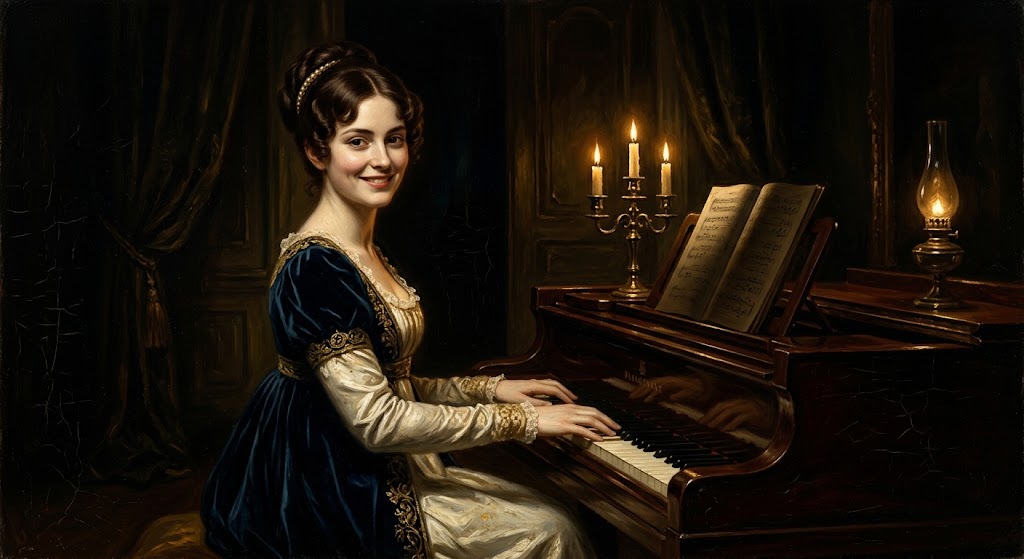
Reverend Jessop, when pressed about the impending arrival of Bishop Middleton, offered warm words about finally having a shepherd for the church in India, but something in his voice rang hollow to those paying close attention. The real tension, he admitted, lay in the fact that he was paid by the East India Company but would soon answer to the bishop’s license — two masters who would almost certainly want different things. A general grumble of agreement passed among the company men at the table, and the subject was quietly dropped as dessert was cleared and Miss Arabella Fitch was asked to play the piano while the party prepared to separate for the evening.
The ladies withdrew to the drawing room, where the shutters had been folded back on the garden and fresh candles lit. Harriet Courtney immediately set about organizing subscriptions and invitations, promising to put the ladies’ names down for the Chowringhee Theatre and the subscription concerts at the new Town Hall. Diana Lockhart, far less concerned with propriety, leaned in to share gossip about Harriet and Magistrate Ashworth, suggested the party attend one of Baijnath Mullick’s lavish nautch entertainments — the man whose carriage was famously pulled by zebras — and dismissed Lady Anne Pelham’s scandalized objections with cheerful irreverence. The conversation turned to the upcoming festivals, with Lady Anne describing Kali Puja as a horrible local affair involving a black goddess with a necklace of heads and the slaughter of goats by the hundred, while Mrs. Wright quietly added that a friend of her husband’s had once heard singing from the Baranagar temple drifting across the water at three o’clock in the morning. Meg Cavendish, by contrast, described watching the Hooghly River fill with floating lights during Diwali as the loveliest thing she had ever seen in India — though she added she wouldn’t go within a mile of it.
As the evening wound down and carriages were called, a brawl erupted among the servants near the palanquins — Cartwright’s man, deep in his own cups, had gotten into a fight with one of the bearers, while Ratan limped away from the chaos already bearing the marks of his earlier punishment. Bakar Ali waded in with a short thick stick, and Magistrate Ashworth raised his voice to talk over the noise while every guest politely pretended not to notice. Georgiana Wentworth, however, spotted something the others had missed: two servants quietly dragging an unconscious Percy Cartwright toward his carriage, trying to conceal his state from the assembled company. She pointed it out loudly, shattering the polite fiction the entire party had been maintaining, and earning a sharp remark from Diana Lockhart for her trouble. The magistrate personally saw his guests off bareheaded at the steps, reminding them of the hunt and asking Adrien to think seriously about Chandernagore, before the carriages rattled away into the dark.
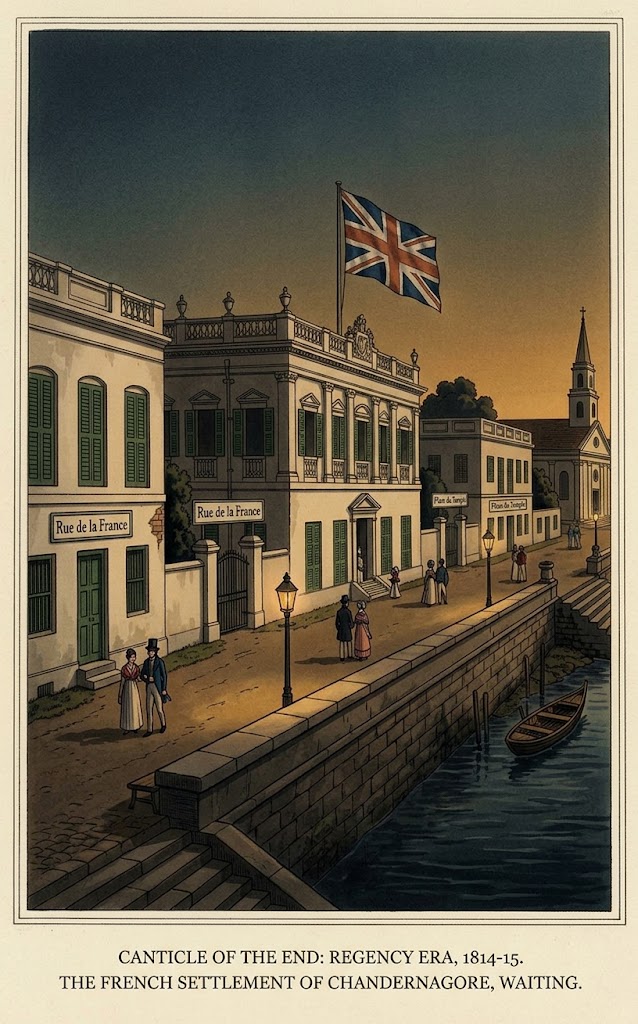
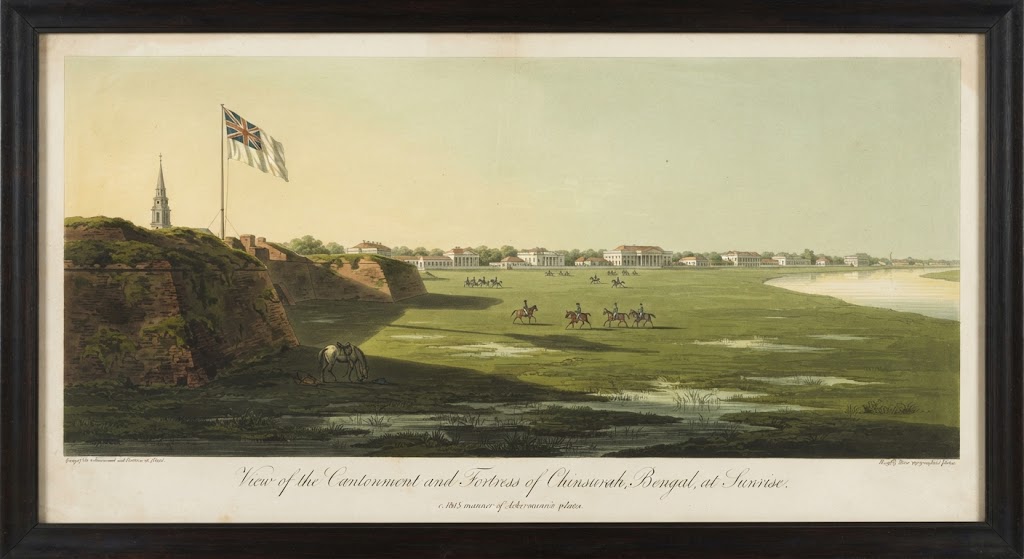
Back at the Cavendish Compound, the party gathered over late-night snacks to coordinate the week ahead. Adrien announced his intention to travel upriver to the French colony of Chandernagore on behalf of Magistrate Ashworth, who needed a Bourbon viscount to survey property titles and reassure the French population that their claims would be honored during the handover. The party agreed to travel together as far as the temple at Baranagar on Thursday, stopping overnight before Adrien continued north. Freddy quietly asked Pratap Singh to arrange a security detail for the compound within three days, and suggested to Hugh Cavendish that he begin thinking about getting his family out of the city before the Kali Puja festival on the 25th. Hugh agreed to discuss it with Meg, then excused himself for an early start at the Strand.
Morning brought kedgeree, toast, and the day’s mail, including a formal invitation by command of the Governor General to a ball and supper at Government House on Tuesday evening (Government House Ball Invitation), and the tiger hunt arrangements confirming the party should assemble at Garden Reach at five o’clock on Saturday morning (Tiger Hunt Arrangements). Pratap Singh, meanwhile, had already been busy, coordinating with sepoys from the fort to set up a steeplechase course and tilting rings on The Maidan, complete with a canopy, refreshments, and cucumber sandwiches with the crusts cut off. The equestrian events that followed were, by any measure, a disaster: Adrien and Thomas collided spectacularly into the jumping fences and ended up in a heap on the ground with their horses wandering off to find grass, while Freddy crossed the finish line being dragged along with his foot caught in a stirrup. The only thing that salvaged the morning’s dignity was the arrival of Sophia Surlish on horseback, who watched the chaos with amusement and accepted an invitation to join the tilting competition.
The tilting proved a far more elegant affair. Sophia demonstrated her skill in the first round by ringing her own hoop and then carrying on to take the one Freddy had just missed, handing it back to him with a smile. After three rounds, Thomas Wyndham emerged as the sole winner, and Pratap Singh unveiled the prize: an extravagant cave à liqueur containing two types of brandy and a full crystal serving set, which drew appreciative murmurs from the gathered crowd. Thomas immediately opened the brandy to share, and Sophia lingered to discuss the selection with Freddy, her interest in him rather more than conversational. Pratap Singh had quietly warned her that her husband might not look kindly on her participation, but she had dismissed the concern with a confidence that suggested she was well practiced at managing Hawthorne Surlish’s temper.
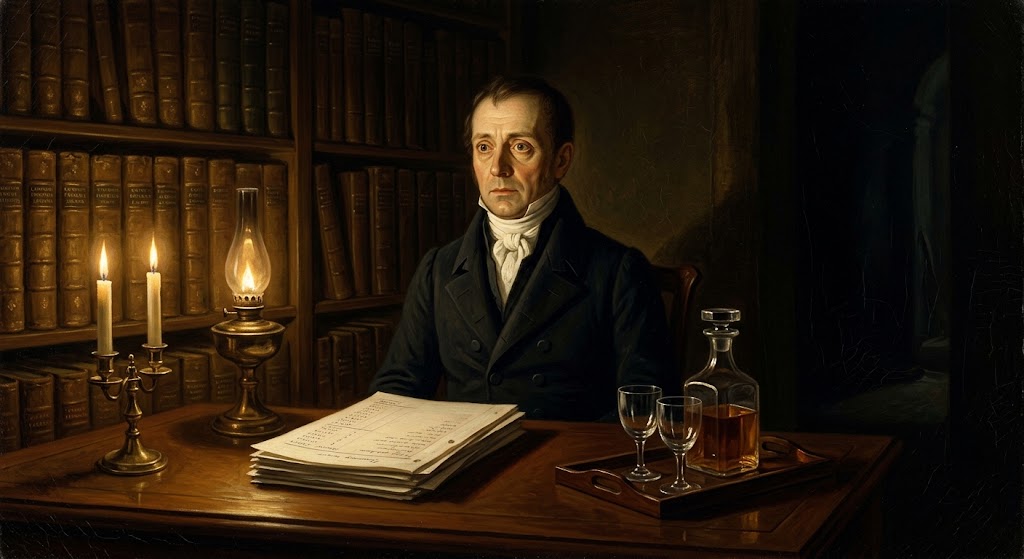
While the gentlemen were occupied on the Maidan, Emma and Georgiana Wentworth traveled to the Strand to visit Mr. Pargeter, their family’s financial agent, whose offices occupied a narrow brick building near Clive Street (Pargeter and Co). They had come to investigate two consecutive missing half-yearly remittances — both the Michaelmas and Lady Day payments — that had failed to reach the family solicitor in Salisbury (Wentworth Letter From Salisbury). Pargeter initially attempted to dismiss their concerns as matters beyond the proper interest of ladies, but the sisters pressed him, and he eventually explained that he had moved the family’s capital from failing indigo lands into a go-down syndicate on the Strand, claiming it paid better returns. He insisted the funds were temporarily tied up in a reinvestment call and that he had not written because the difficulty would be resolved before any letter could reach England and back. Georgiana, watching him carefully, could see that he was afraid of something — rehearsed in his answers, ashamed beneath the smooth professional surface — and when she pressed him further, he revealed that the syndicate in question was run by Baijnath Mullick.
The name landed quietly, but its implications were anything but. The same extravagant merchant whose zebra-drawn carriage had been the talk of the drawing room the night before was now revealed as the man holding the Wentworth family’s money. The sisters pressed Pargeter to write a letter to their father explaining the situation, which they intended to deliver personally, and took their leave with the distinct impression that they had not yet heard the full story. On the way out, Georgiana noticed that several other client pigeonholes in the office were similarly thin or empty — all of them bearing English family names — suggesting the Wentworths were not the only ones caught in whatever arrangement Pargeter had made.
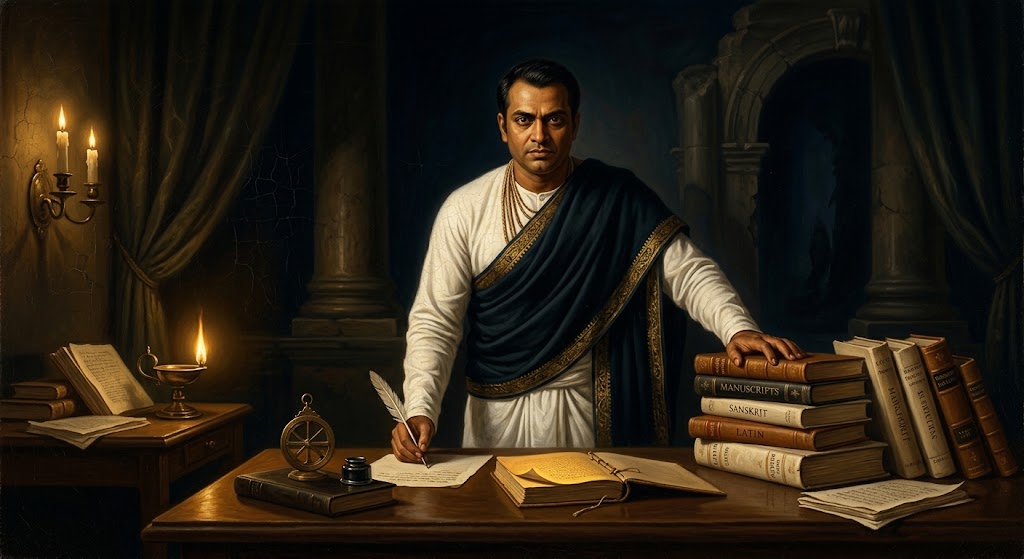
Katherine, meanwhile, had spent the morning in the dusty back offices of the Calcutta Gazette, working through decades of bound newspaper volumes with the help of a paid clerk. When Emma and Georgiana joined her, the search began to yield results. They found reports of lascars vanishing from the riverfront at night, inquest notices recording suspicious deaths at the Zorab and Sons go-down on the Strand, and a series of letters to the editor debating the disappearances near the Baranagar temple. The letters referenced a correspondent named Rammohun Roy, who had written original articles on the subject — but those articles were nowhere to be found in the archives. Someone had removed them.
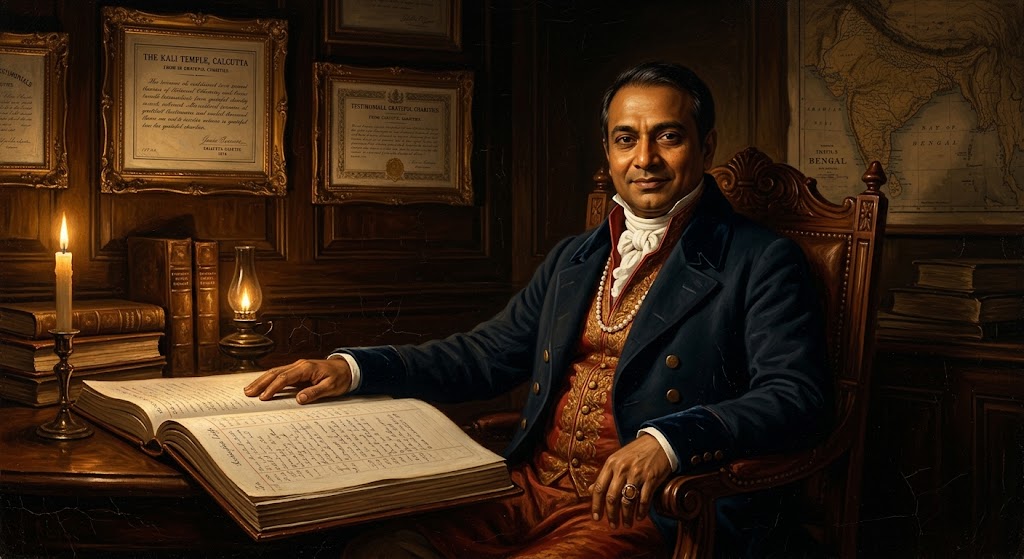
What remained was enough to sketch the shape of something troubling. Roy had observed that three persons had gone unaccounted for from the temple’s neighborhood, and that the establishment had offered the same form of words in each case — a coincidence, he wrote, or not a coincidence at all. His critics accused him of hinting at the complicity of respectable native merchants without evidence. A notice also announced an upcoming publication called the Ghat Mothers, collecting testimonies from women of the Baranagar district whose husbands and sons had been lost to the temple — also translated by Roy, also not yet published. A clerk informed them that Roy had left the paper two years ago after a falling out with the old editor and now lived at a garden house in Maniktala (Roy Garden House), northeast of the city past the last streets any European map bothered to name.
The party also discovered the catalog for an upcoming private sale at Zorab and Sons, scheduled for Wednesday evening (Zorab Sale). Among the lots were Tibetan bronze figures, rough and cut turquoise, and two items of particular interest: a collection of manuscripts in an unidentified script on a paper resembling birch bark, and a sealed reliquary of unknown metal and curious workmanship whose contents had not been ascertained and would not be opened before the sale. The threads were beginning to multiply — missing money, missing articles, missing people, a sealed box that no one had looked inside, and a man who had once written about all of it now living quietly at the edge of the city, two years removed from the paper that had published him. The week ahead was going to be a busy one.