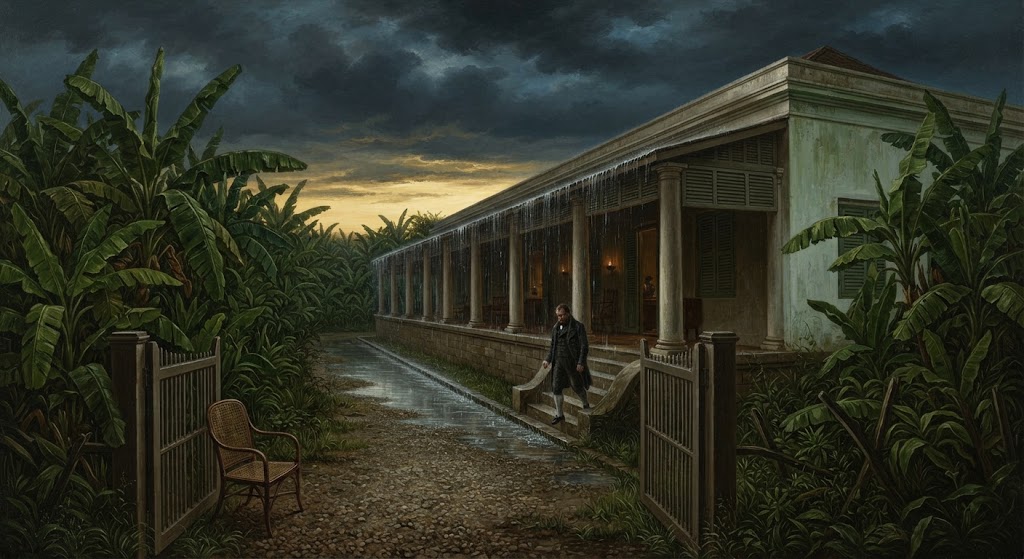
Description
Hugh and Meg’s walled compound in Chowringhee, and the party’s domestic base for the whole of Chapter 4. A single-storey bungalow raised on a plinth against the wet, with a deep pillared verandah running the full front and jhilmil shutters closed against the sun and opened at night. High ceilings, punkahs, matting rather than carpet. Cool by design and never quite cool.
Around it: outbuildings, stables, a garden gone violently green, and the servants’ lines.
Notable Features
- The establishment. A full household in the Bengal manner, and the roles are distinct and worth naming at the table: the durwan on the gate, the khansama who runs the house, khidmutgars at table, the ayah who has most of Little Freddy’s daily care, bearers, a syce, a mali, a dhobi, a bheestie carrying water, and sweepers at the bottom of a hierarchy the British do not see and the household observes exactly.
- The durwan’s chair is positioned to see the whole carriage drive and the servants’ path at once. That is not an accident.
- Little Freddy’s room. Two years old, named for Freddy Cavendish. Establish the geography of this room lightly and early and never point at it.
- The verandah is where the party gets its first unstructured hour ashore. See Scene 09 The Gather.
The Plan
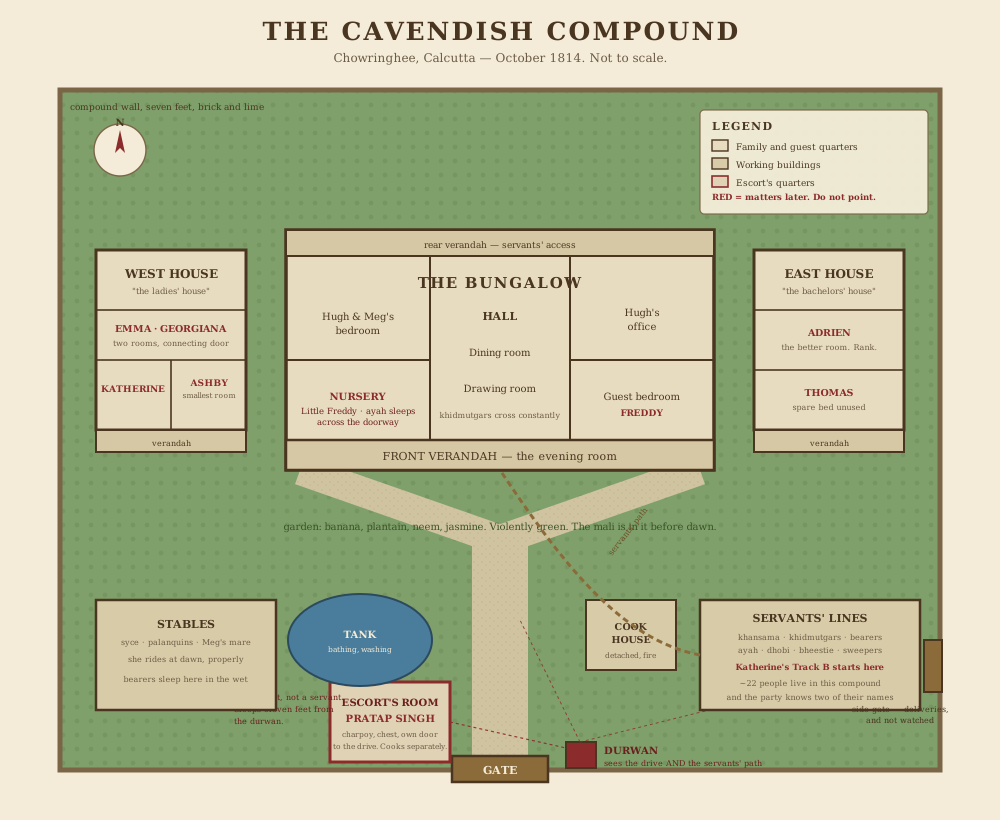
A central bungalow with two detached guest houses, which is how a Company factor of Hugh’s standing houses eight unexpected arrivals without anyone sleeping in a corridor. Guest houses of this kind are ordinary in Calcutta compounds: a family builds one for visiting relatives, for a bachelor brother, for the season when everyone comes down from the districts.
Hugh has two, and both have been standing half empty for years. He is delighted to fill them.
The Buildings
The bungalow
Single storey, raised on a plinth of about three feet against the wet, with a deep pillared verandah running the full front and a shallower one behind for servants’ access. Tiled roof, high ceilings, jhilmil louvred shutters closed against the sun and folded back at night. Matting on the floors rather than carpet, because carpet rots.
Front to back: the front verandah is the evening room and where everything that matters gets said. Inside, a central hall with the dining room and drawing room off it, Hugh and Meg’s bedroom and the nursery to the west, Hugh’s office and a single guest bedroom to the east.
Freddy is in the house. Not in a guest house. Hugh would not hear of his cousin sleeping anywhere but under his own roof, and the room was made ready a week before the ship was sighted.
The West House, which the household calls the ladies’ house
Four rooms and its own verandah, forty yards west across the garden.
- Emma and Georgiana have the two front rooms with a connecting door, which Meg arranged without being asked because sisters.
- Katherine has a room at the back, off the passage.
- Ashby has the smallest room, at the back, nearest the servants’ path.
The East House, the bachelors’ house
Two rooms and a verandah, forty yards east.
- Adrien has the better of the two, because he is a Viscount and Hugh, who is untroubled by nearly everything including the recent war, thinks that is simply correct.
- Thomas has the other, which has a spare bed in it that nobody is using.
The escort’s room
Pratap Singh is quartered in the compound, in a small whitewashed room built against the wall beside the gate. A charpoy, a chest, a peg, and his own door onto the drive. It was put up years ago for a chowkidar Hugh no longer employs and it has stood empty since.
He does not sleep in a guest house and he was never going to. A havildar of the 67th assigned as escort to visiting Britons is not a guest, and nobody in the household, including him, would find the suggestion anything but embarrassing.
He does not sleep in the servants’ lines either. He is a high-caste NCO of the Bengal Native Infantry, he holds the Company’s warrant, and he outranks every man in those lines in a way that has nothing to do with the household’s hierarchy and cuts straight across it. He cooks for himself, eats alone, and observes his own dietary practice, which is completely ordinary, entirely correct, and means that nobody in this compound thinks it strange when he is not where he was.
The working buildings
Servants’ lines along the east wall, cookhouse detached because of fire, stables to the west with the syce, the palanquins and Meg’s mare, and a masonry tank in the middle of the garden for bathing and washing.
About twenty-two people live inside this wall, plus the escort at the gate. The party can name two of them.
The Gate, and the Other Gate
The main gate is at the south, with the durwan’s chair beside it, positioned so that one seated man sees the whole carriage drive and the servants’ path at the same time. That is not an accident and it is not sinister. It is what a durwan’s chair is for, in every compound in Chowringhee, and the gatemen of those compounds talk to each other every evening. See Calcutta 1814, Surveillance Networks.
The side gate is at the north-east corner, for deliveries and the bheestie’s water. Nobody watches it, because there is nothing to watch: it opens onto a service lane used by the households on either side.
The Senses, Room by Room
- The front verandah at night. Rain off the roof into a gravel channel in an unbroken sheet, loud enough that a conversation four feet away is private. Lamps turned low because of the insects. Everything past the rail is solid black.
- The hall and drawing room. Matting, damp lime plaster, lamp oil, beeswax. Dark polished wood and brass that somebody cleans daily. A khidmutgar crosses more often than anyone counts.
- The guest houses. Newer, plainer, and smelling faintly of disuse: dry matting, whitewash, and the particular cold-stone smell of a room that has been shut.
- The garden between them. Banana, plantain, neem and something flowering heavily at night. Warm and thick and green past the point of looking natural.
- The lines at dawn. Woodsmoke, cooking oil, water being drawn, and about twenty people beginning a day the party will sleep through.
The Geography That Matters Later
Connections
- Chowringhee
- Hugh Cavendish, Margaret Cavendish
- Scenes: Scene 04 Cavendish Compound, Scene 09 The Gather
Appearances
Relationships
- Part of Chowringhee — A walled compound in the European quarter
- Owned by Hugh Cavendish — Hugh's household
- Owned by Margaret Cavendish — Meg runs it