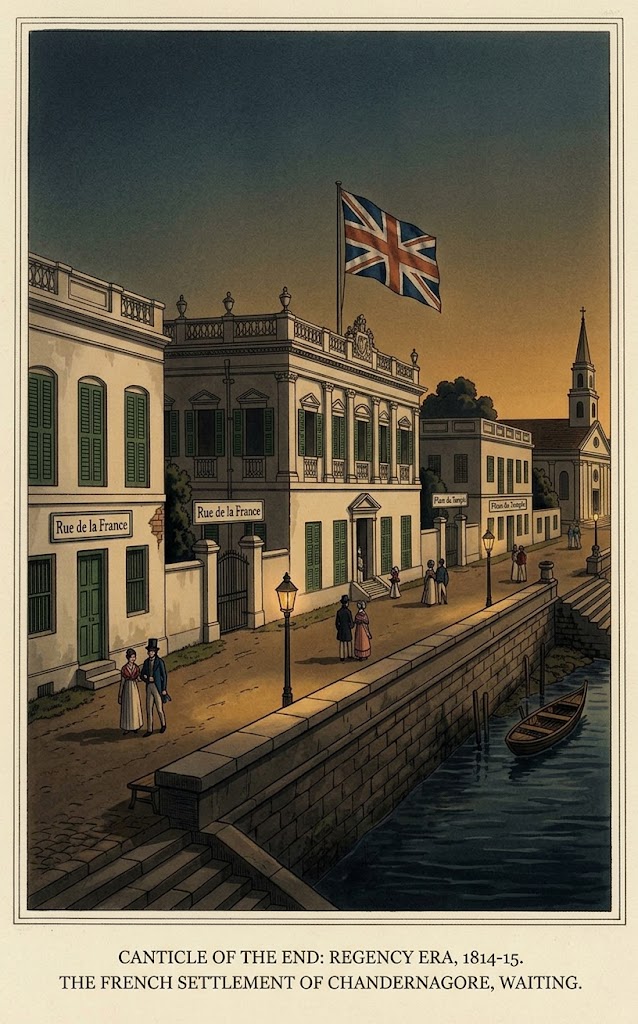
The French settlement on the Hooghly, roughly twenty miles above Calcutta.
Description
The French settlement on the Hooghly, roughly twenty miles above Calcutta. Britain took it in 1793 and has administered it ever since.
Under the Treaty of Paris of 30 May 1814, French possessions in India are to be restored to their boundaries of 1 January 1792. The actual handover does not happen until 1816. So in October 1814 Chandernagore is still British-run, and everybody in it knows that is about to stop.
It sits with Chinsurah (Dutch, occupied 1795) and Serampore (Danish, occupied 1808) in a cluster of small European enclaves strung along the same stretch of river.
Notable Features
- The community. Twenty-one years under a foreign administration, about to be handed back to a France most of the younger ones have never seen, which has just changed its form of government while they were not looking. Some are royalist and relieved. Some made their peace with the Empire and are quietly working out what that will cost. Most simply want to know whether their 1792 property titles still mean anything.
- They are not a faction and they want nothing from the party. They are a mirror.
- Serampore is in the same cluster, and being Danish it lies outside Company jurisdiction, which matters enormously for anything the party wants printed.
The Senses
- Smell. River, wet brick, and incongruously the smell of a French provincial town: baking, wine casks, tobacco.
- Sound. French spoken in the street, and church bells on a different pattern from St John’s.
- Colour. Shuttered pastel frontages going grey with damp, a formal riverside promenade with the trees badly kept, and the brown river past them.
Connections
- The Hooghly River
- Baranagar lies on the route
- Adrien de Montferrand
- Baptist Mission Press Serampore
Appearances
Relationships
- Part of The Hooghly River — French enclave on the river
- Adjacent to Baranagar — The route upriver passes the temple
- Significant to Adrien de Montferrand — His documented reason to travel upriver