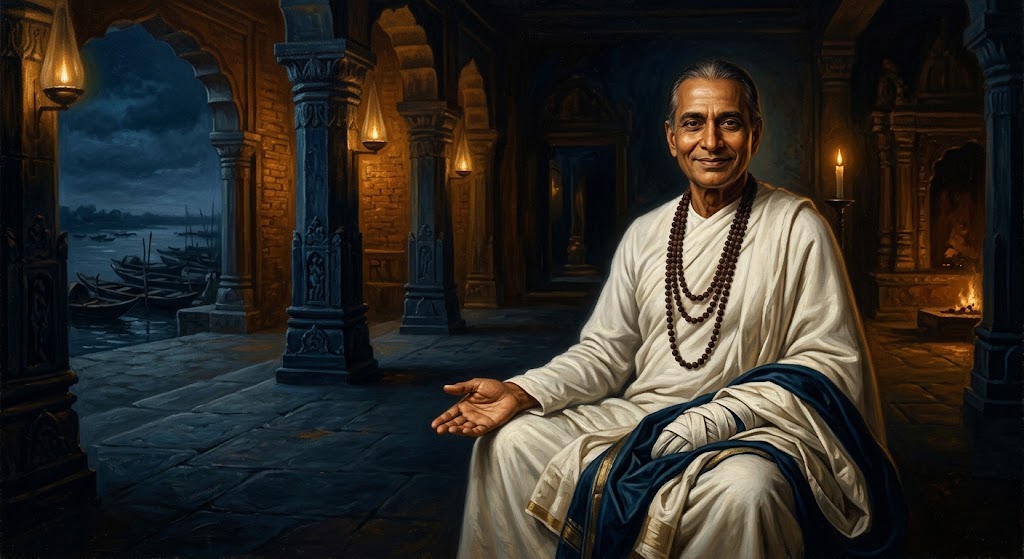
Description
A charming elder Indian gentleman, warm and hospitable, who keeps an easy charm at the head of his own table. Beneath his robes, his arm from the elbow down is a sinuous tentacle, sprouting fronds where the fingers once were.
At his own dinner table on 13 October 1814 he dropped the host’s manner before the upriver party: his cult, he said, is in every rung of the British government, the East India Company, the military and the judiciary; what is coming is preordained; and the ritual on the night of Kali will open a gate for Yog-Sothoth. He had Kaunitz unmade by his servants in front of them, told Georgiana she was achieving samapti, becoming one with the universe, and invited her to join them (Samapti at Ghoshs Table).
Ghosh is the Acharya of the Mandir Mahakali at Baranagar Ghat, on the east bank of the Hooghly north of Calcutta. He is the leader of the Aeternum Choir’s Calcutta cell, and his written voice combines the authority of a man at home in sacred tradition with open contempt for his European counterparts. He does not seek Herzfeld’s approval. He informs him.
His letter to Albin Herzfeld carries the particular confidence of someone who regards comparison with European occult practice as faintly insulting. “Your European methods of concealment are fragile. Ours are not. The British see a temple. They do not see what the temple contains.”
Background
Ghosh’s family line has served at the Mandir Mahakali since what he calls “the first utterance of the name that opens the gate” — a phrase implying his cell’s work predates the Choir’s European operations by centuries, or that it was an original site rather than a recruited one. He claims the Calcutta cell’s traditions predate European civilization by three thousand years.
The Mandir Mahakali sits at Baranagar Ghat, north of Calcutta on the east bank of the Hooghly. As a functioning temple, it provides cover that Ghosh regards as unbreakable: the British colonial apparatus sees a place of Hindu worship. It does not see the ritual infrastructure beneath or behind that fact.
The yantra, the ritual instrument specific to the Calcutta cell’s working, was complete at the time of writing. Singers have been selected from those whose throats carry the svarita, the tone between tones. The ritual is planned for 25 October, Kali Puja, in the month of Kartik.
Connections
- Aeternum Choir — Calcutta cell leader
- Mandir Mahakali — Temple and ritual site on the Hooghly at Baranagar Ghat
In Play
Chapter 4, Session 9 (9 October 1814) — vouched for, in person, by the Magistrate of Calcutta. At his own table at Garden Reach, Charles Ashworth described Ghosh to Adrien as a personal friend, a charitable and hospitable gentleman, and one of the finest men he knows, and recommended Adrien lodge with him at Baranagar on the way to Chandernagore. See Ashworth Dinner Garden Reach.
The party already held his name from Georgiana’s overnight work, and sat there while the most credible Englishman in Bengal offered them a bed at the enemy’s house. An open invitation to walk into the temple’s own village now exists, extended by the British administration.
Chapter 4, Session 10 (9–10 October 1814) — the Magistrate told the party how the friendship began. At the third course at Garden Reach, Ashworth gave the party his own account of their first meeting: the 1793 Settlement survey of the northern suburbs, Ghosh arriving in person with his papers and self-taught English, right on every point and naming the bribed surveyor; the flood the following year, the village fed from the temple granary, the subscription given anonymously. The party now holds the friendship as the Magistrate’s own story, in his own words, and knows Ghosh has never asked him for anything in twenty years.
Appearances
- Session 15 - The River of Rites and Ruin — received the upriver party at his house with Ashworth’s letter; at dinner revealed his cult’s reach and the night of Kali, had Kaunitz unmade by his servants, showed Georgiana his arm and invited her to join, then left the party as not worth killing.
Connections
People
Enemy of
- Ram Mohan Roy NPC hostileGhosh is everything Roy's anti-idolatry campaign opposes made concrete. Roy's decade of documentation is the most credible independent evidence against him.1 session: The Governor's Ball
Knows
- Albin Herzfeld NPC hostileWrote to Herzfeld confirming Calcutta preparations; tone is dismissive of European methods, which he regards as fragile compared to his own traditions
Served by
- Otto von Kaunitz NPC warmUnmade by samapti at Ghosh's dinner table on 13 October 1814 and given back distorted and broken; now Ghosh's meek, compliant servant. Before that, his window into British society.1 session: The River of Rites and Ruin
Trusted by
- Charles Ashworth NPC warmTwenty years of acquaintance. Ashworth regards him as a remarkable man and an ornament to the city.3 sessions, The Magistrate's Table to The River of Rites and Ruin
Places
Located at
- Mandir Mahakali Location warmAcharya of the temple on the east bank of the Hooghly at Baranagar Ghat; his lineage has served there since the first utterance of the name that opens the gate3 sessions, The Magistrate's Table to The River of Rites and Ruin
Served by
- Mandir Mahakali Location warmGhosh serves as Acharya; his lineage has served at the temple since its founding3 sessions, The Magistrate's Table to The River of Rites and Ruin
Visited
- Ghosh House Location1 session: The River of Rites and Ruin
Organisations
Leads
- Aeternum Choir Faction warmLeads the Calcutta cell from the Mandir Mahakali; his lineage has served the cult's work at this site since its founding
Events
Participated in
- Ashworth Dinner Garden Reach Event neutralAbsent, and vouched for by the most credible man in Bengal
- Samapti at Ghoshs Table Eventhost; revealed the cult's reach and the night of Kali, and ordered the demonstration
Mentions
Sessions
People
Places
Events
- Compound Council 9 October
- Kali Puja Date Identified
- Renwick Located at Baranagar
- Roy Garden House Consultation