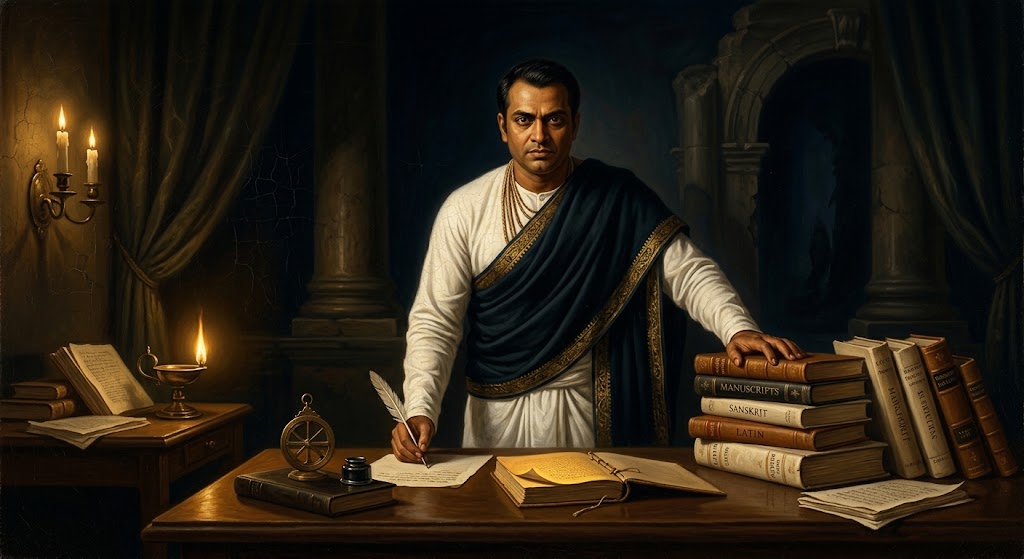
Description
Historical figure. Forty-two. Bengali Brahmin polymath. Fluent in Bengali, Sanskrit, Persian, Arabic, and English. Wealthy (zamindari holdings, moneylending). Just resigned from East India Company service and settled permanently in Calcutta in 1814 to devote himself to reform.
Fearless, combative, intellectually formidable. Debates Brahmin pandits and British officials with equal fluency. Not paranoid, angry. Not broken, fighting. Socially confident, generous, principled. His own orthodox family opposed him for years; he didn’t bend.
Background
Founded the Atmiya Sabha (Society of Friends): a philosophical circle promoting Vedantic monotheism and campaigning against priestly exploitation, caste rigidity, and empty ritual. He has written for years against the priests of Baranagar. Some of his articles no longer appear in the Gazette’s bound volumes.
Related
- Places: Roy Garden House (his home at Maniktala, where the Atmiya Sabha meets)
- People: Katherine Ward, Elizabeth Ashby, Adrien de Montferrand — trusted with his full account of Surlish’s suppression campaign and the Baranagar temple, Session 12
In Play
Chapter 4, Session 10 (9–10 October 1814) — found in the back files, by his absence. At the Gazette the party found the letters to the editor debating his observations — three persons unaccounted for from the temple’s neighbourhood and the same form of words from the establishment each time; his critics accusing him of hinting at respectable native merchants without evidence — and the subscription notice for The Ghat Mothers, never followed by publication. Where his original articles should have been there was a gap: someone had removed them. A clerk told them he left the paper two years ago after a falling-out with the old editor and now lives at a garden house at Maniktala (Roy Garden House). His name and his house are now known to the party (Gazette Back Files Search).
Chapter 4, Session 12 (12 October 1814) — the account given in full. Katherine Ward, Elizabeth Ashby and Adrien de Montferrand found him at his garden house in Maniktala: gate open, garden lamp-lit, a dozen voices arguing politics and religion in two languages at once. He dismissed his debating guests the moment he heard why the investigators had come, and spoke plainly. His 1811 letter to the Gazette was set in type and then killed after Hawthorne Surlish paid a pleasant visit to the editor and mentioned, once, how much advertising the merchant consortium placed in the paper. Since then Surlish has appeared in the background of every suppression — on the vestry at St John’s, on the subscription list paying the Baranagar temple, always in the room when a petition is mislaid or a complaint dismissed.
He described what happens to the men who go to Ghosh’s temple for a blessing: they come home “soft” at first, their hands and manner changed, and then they stop coming home at all. The priests tell the mothers their sons have reached samapti — completion — and give each family forty rupees. Bimal had drawn one of them for Roy: a man with no bones left in his arm, alive and smiling when the drawing was made. Roy counted thirty soldiers dead or missing near Baranagar since 1812 — eleven found dead (eight with the mark of a cord at the throat), nineteen missing, most of them recorded by the company as deserters. Three cases troubled him most: a soldier whose brother swears the man now answering to his name stands taller than he ever did; an engineer’s sepoy whose boots came out of the river; and a Havildar whose mother had performed his funeral rites, and whose pay had stopped coming home (Roy gave no name for this last man). Almost as an afterthought, he mentioned that an English officer had once asked him about the cord marks on the victims’ throats, and then stopped asking. He kept the Register of the Thirty himself — this was his account told aloud, not the document handed over.
Appearances
Campaign Log
- Session 12 - The Governor’s Ball — At his garden house in Maniktala, dismissed his debating guests to give Katherine Ward, Elizabeth Ashby and Adrien de Montferrand his full account of Surlish’s suppression campaign, the Baranagar temple’s missing men, and thirty soldiers dead or missing since 1812 (eleven found dead, eight with cord marks; nineteen missing). He kept the Register of the Thirty himself, telling it aloud rather than handing it over.
Connections
People
Enemy of
- Acharya Devendra Ghosh NPC hostileGhosh is everything Roy's anti-idolatry campaign opposes made concrete. Roy's decade of documentation is the most credible independent evidence against him.1 session: The Governor's Ball
Knows
- Anne Pelham NPC neutralHas heard his complaints dismissed at her own table2 sessions, The Third Course to The Governor's Ball
- Bimal NPC warmDrew what he had seen, at Roy's request1 session: The Governor's Ball
- Roderick Pelham NPC hostileRegards him as a mischief-maker; has never read him closely
Trusts
- Adrien de Montferrand Player character warmDismissed his debating guests to give him his account of Surlish's suppression and the Baranagar temple, Session 122 sessions, The Third Course to The Governor's Ball
- Katherine Ward Player character warmDismissed his debating guests to give her his account of Surlish's suppression and the Baranagar temple, Session 122 sessions, The Third Course to The Governor's Ball
- Elizabeth Ashby NPC warmDismissed his debating guests to give her his account of Surlish's suppression and the Baranagar temple, Session 121 session: The Governor's Ball
Places
Owns
- Roy Garden House Location neutralHis Calcutta residence at Maniktala since resigning Company service in 1814, and where the Atmiya Sabha meets2 sessions, The Third Course to The Governor's Ball
Events
Discovered by
- Gazette Back Files Search Event neutralNamed as the correspondent whose articles are missing; located at Maniktala
Participated in
- Roy Garden House Consultation Event neutralGave his full account of Surlish and the temple, aloud
Mentions
Sessions
People
Places
- Asiatic Society of Bengal
- Baptist Mission Press Serampore
- Barabazar
- Calcutta Gazette Office
- Writers Building