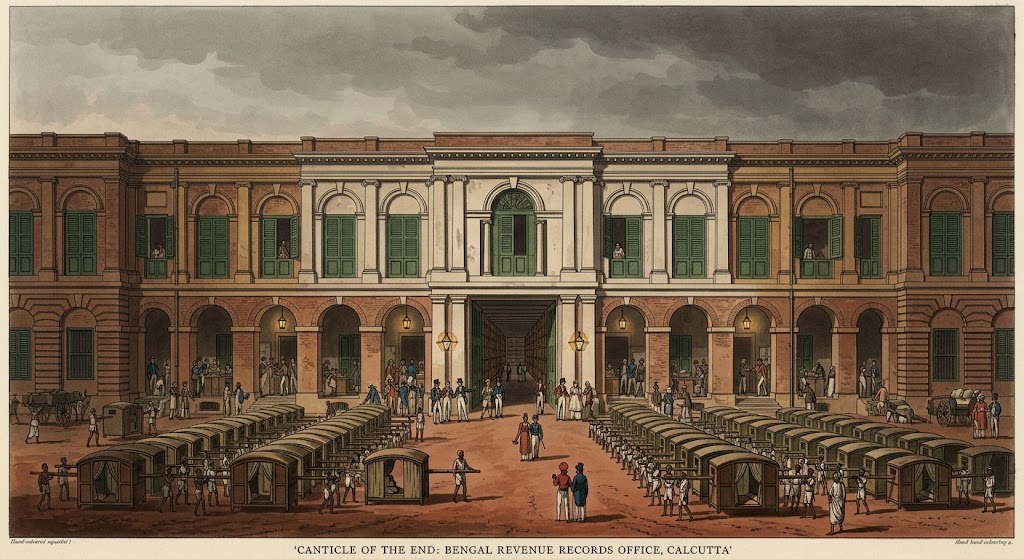
The long range filling the north side of Lal Dighi, built in 1777 to house the Company's junior civil servants (its "writers") and now the administrative machine of the Bengal Presidency.
Description
The long range filling the north side of Lal Dighi, built in 1777 to house the Company’s junior civil servants (its “writers”) and now the administrative machine of the Bengal Presidency. Revenue, judicial, marine and political departments, each with its own records and its own clerks.
Everything the Company has ever been told is in this building. Whether anyone can find it is a different question.
Notable Features
- The filed and forgotten. Roy’s 1812 letter to the Collector is here, stamped RECD 14 FEB 1812 and annotated “Filed. No action required.” in a clerk’s hand.
- The Collector’s district records for the Twenty-Four Pergunnahs, including Baranagar.
- Access is by standing, not by fee. Freddy’s Board of Control paper works. So does a word from Ashworth, which is a favour with a cost.
- Clerks are the real gate. A helpful one saves a week. An obstructive one is unanswerable.
The Senses
- Smell. Dry paper, sealing wax, ink, and the mildew that gets into everything bound in this climate.
- Sound. A hundred pens, punkah ropes, and the flat drone of a place where nobody speaks above a murmur.
- Colour. Whitewash gone yellow, red tape (literally, the Company’s own), and brown paper tied in bundles to the ceiling.
Connections
- Lal Dighi
- Charles Ashworth
- Ram Mohan Roy
- Calcutta Investigation Locations
Appearances
Relationships
- Part of Lal Dighi — Fills the north side of Tank Square
- Concerns Ram Mohan Roy — Where his letters were filed without action