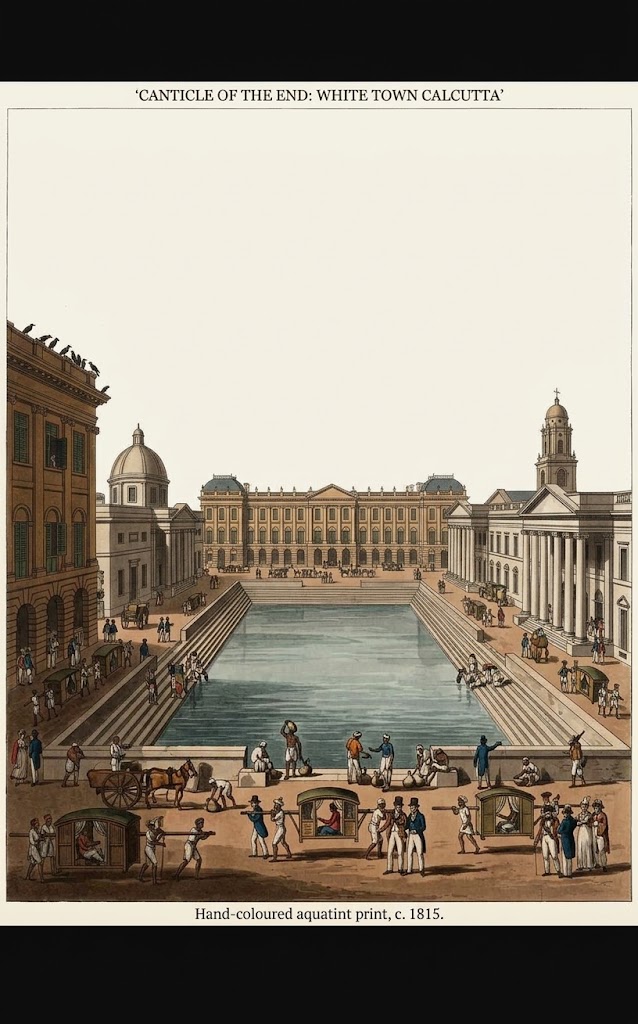
The central square of White Town, built around a large rectangular masonry tank that has supplied the settlement with drinking water since before the Company had a fort worth the name.
Description
The central square of White Town, built around a large rectangular masonry tank that has supplied the settlement with drinking water since before the Company had a fort worth the name. The Writers Building fills one side. The post office, the auction rooms and the public notice boards are here.
News enters Calcutta here and leaves here. A thing posted at Lal Dighi in the morning is discussed in Chowringhee drawing rooms by evening and in the bazaar by dark.
Notable Features
- Public notices are posted here, including Company proclamations, sale advertisements and shipping intelligence.
- The auction rooms. Estates of the deceased are disposed of constantly, because Europeans die here constantly.
- The tank itself. Steps down on all four sides, and the water used by everyone for everything.
The Senses
- Smell. Standing water, hot stone, horse, and paper glue off the notice boards.
- Sound. Palanquin bearers calling, auctioneers through open windows, and the particular hum of a place where everyone is exchanging information.
- Colour. White stucco all round, a flat green rectangle of water in the middle, and red-brown dust over everything not recently rained on.
Connections
- Writers Building
- Government House nearby
- The Strand west
- Chitpur Road runs north from here
Appearances
Relationships
- Part of Calcutta 1814 — The civic centre of White Town
- Adjacent to Writers Building — Fills the north side of the square
Places Within
Calcutta Gazette Office
The Calcutta Gazette has printed since 1784 and is the government's paper, which means it prints what the Company wants printed and, far more usefully, everything the Company requires to be printed: proclamations, shipping intelligence, insolvencies, estate sales, inquest returns, births, marriages, deaths, and advertisements from anyone who can pay.
Writers Building
The long range filling the north side of Lal Dighi, built in 1777 to house the Company's junior civil servants (its "writers") and now the administrative machine of the Bengal Presidency.