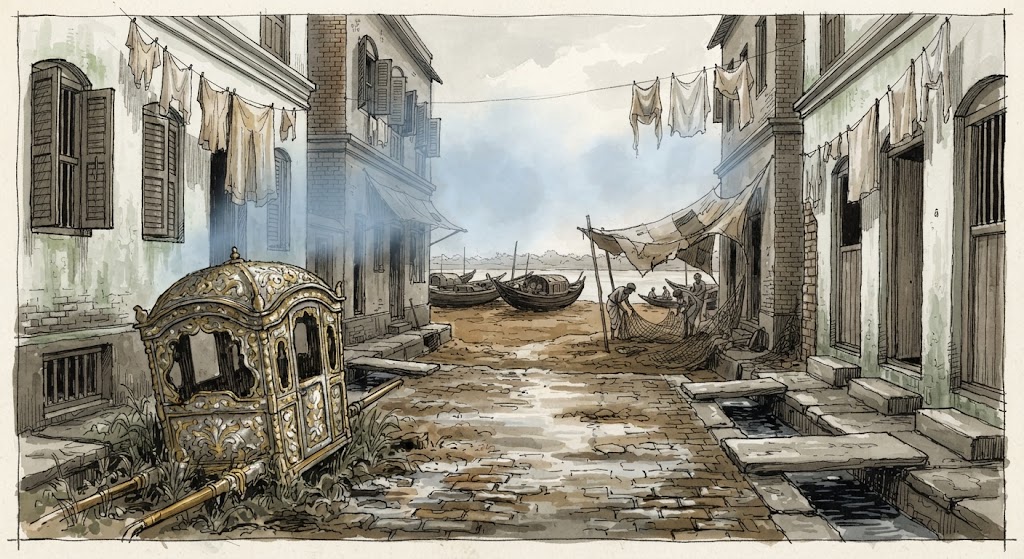
One of the three villages Calcutta grew out of, and now the northern part of Black Town.
Description
One of the three villages Calcutta grew out of, and now the northern part of Black Town. Cotton and cloth were traded here before the Company existed. It sits on the river and the river is what it does.
Going north from Lal Dighi the streets narrow, the whitewash stops, the language changes, and within twenty minutes there is not another European face. Calcutta 1814 calls this the two-world transition and asks for it to be played as a sensory event rather than a journey.
Notable Features
- The palanquin stops working as a conveyance well before the lane ends. The bearers set it down without being asked, because they know where it stops fitting.
- Sarala Dasi, Malati and Nikhil Dasi live here. The Dasi family have run cargo on the Hooghly for generations and are load-bearing for the climax.
- Anyone in European dress is watched the whole way in, and remarked on afterwards.
- Bengali only. Elizabeth Ashby is fluent. No investigator follows a word.
The Senses
- Smell. Cooking oil, woodsmoke, open drain and river, layered together and not unpleasant.
- Sound. A woman calling the same two words over and over somewhere close, goats, children keeping pace at a distance.
- Colour. Ochre and unfired brick, cooking smoke going blue at first-floor height, cloth in colours White Town does not wear, and the flat brown river at the end of it.
Connections
- Chitpur Road runs up to it
- The Hooghly River
- Sarala Dasi, Malati, Nikhil Dasi
- Scene: Scene 07 Sutanuti
Appearances
Relationships
- Part of Calcutta 1814 — The northern Indian quarter
- Origin of Elizabeth Ashby — Her mother's household and her homecoming
- Residence of Nikhil Dasi — The Hooghly boat family