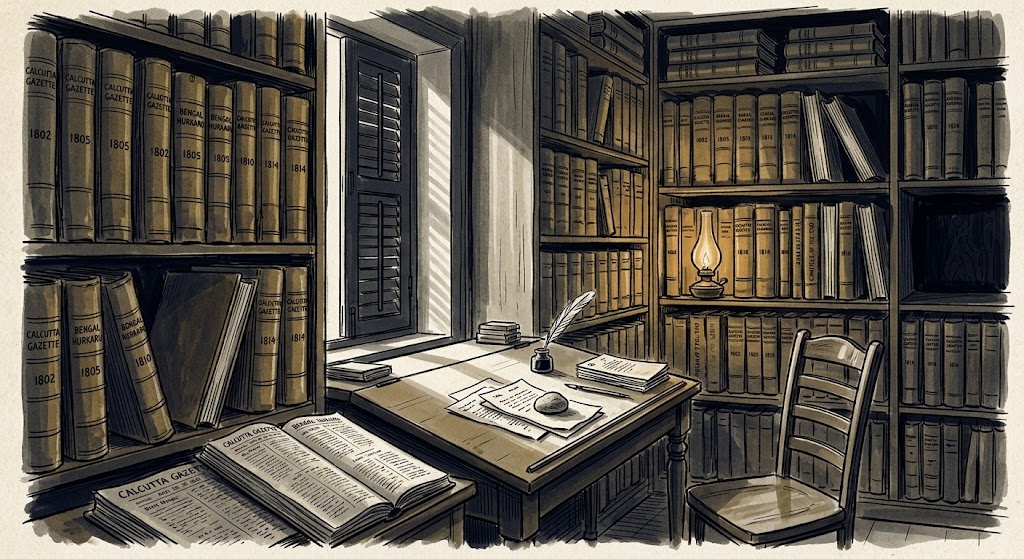
The Calcutta Gazette has printed since 1784 and is the government's paper, which means it prints what the Company wants printed and, far more usefully, everything the Company requires to be printed: proclamations, shipping intelligence, insolvencies, estate sales, inquest returns, births, marriages, deaths, and advertisements from anyone who can pay.
Description
The Calcutta Gazette has printed since 1784 and is the government’s paper, which means it prints what the Company wants printed and, far more usefully, everything the Company requires to be printed: proclamations, shipping intelligence, insolvencies, estate sales, inquest returns, births, marriages, deaths, and advertisements from anyone who can pay.
The office keeps bound back files. A clerk will fetch them for a small fee and will not care why.
This is the party’s primary documentary resource in Calcutta and the one most likely to be underused, because players expect archives to be gated and this one is not.
Notable Features
- Bound volumes by year, and a rudimentary index that covers proclamations only. Everything else is read by hand.
- The other papers. The Bengal Hurkaru and the India Gazette also print, and a thorough researcher checks all three, because what one suppresses another may carry.
- No editorial memory. Nobody at the office remembers anything. The paper is a machine that ate the city’s information and will give it back to anyone patient.
The Senses
- Smell. Paper, printing ink, dust, and the sweetish rot of bindings that have been through eleven monsoons.
- Sound. A press working in the next room, and nothing else.
- Colour. Brown. Foxed paper, brown ink gone rusty, dark shelving, one window.
Connections
- Lal Dighi
- Calcutta Investigation Locations
- Ram Mohan Roy
Appearances
Relationships
- Part of Lal Dighi — Near the civic square
- Concerns Ram Mohan Roy — The suppression is visible here as absence