Calcutta — The Cycle of Dissolution
The Governor's Ball
The grand ballroom of Government House blazed with candlelight and the chatter of five hundred guests as the party made their entrance in the latest Viennese fashions. Emma Wentworth caused an immediate stir by wearing tiger claws woven into her hair, a bold choice that set tongues wagging and started what would become a genuine fashion trend among Calcutta’s elite. Thomas Wyndham wasted no time in claiming the first and last dances on Emma’s card, dismissing a nervous young Scottish suitor named Glennie with a muttered remark about what a little squid the boy was. Freddy Cavendish, meanwhile, found himself in a tense near-confrontation with the merchant Hawthorne Surlish, who offered a mocking handshake before coldly pulling his wife Sophia away without so much as a proper introduction, leaving her to glance back over her shoulder as she was steered toward the drinks table.
Inside the glittering hall, social maneuvering continued at every turn. Diana Lockhart swept to Georgiana Wentworth’s side to warn her, in a low and pointed voice, to be more discreet about her opinions regarding a certain Mr. Cartwright — five hundred guests were present tonight, not forty. Elizabeth Ashby made a rather forward move of her own, handing Adrien de Montferrand her dance card with a smile and the observation that he had already seen her at her worst, twice. Katherine Ward, for her part, firmly and politely declined Adrien’s advance on her own card, a decision that left Diana Lockhart nearly speechless with disbelief that any woman would turn away a man of such wealth and standing.
Out on the dance floor, Emma and Thomas cut a spectacular figure, drawing the crowd’s attention with the latest European steps performed with effortless confidence. Adrien and Elizabeth joined them, and for a time the floor seemed to belong entirely to the four of them, a dazzling display of fashionable movement that put the other guests to shame. The music swelled, the candles flickered, and for a brief, glittering moment, the evening felt entirely ordinary.
It was Georgiana who first noticed something was wrong. Beneath the bright notes of the pianoforte and the laughter of the crowd, she caught a low, persistent humming threading in through the tall windows — not quite in tune with the music, not quite human in quality. She stayed very still, listening, while the rest of the room danced on entirely unaware.
Outside, near the long line of waiting carriages, the horses had begun to scream. Lamps swung wildly on their hooks as two thin figures in wet white cloth moved slowly down the carriage line, swaying slightly, their lips moving in a low murmur. The Cavendish servants, Apoo, Abrar, and Asif, scrambled to control the panicking animals while other handlers dragged their own horses away from the approaching men. One horse lashed out and sent a carriage man flying, and still the two figures came on, unhurried and utterly indifferent to the chaos they were causing.
Katherine Ward and Freddy Cavendish had come outside — Katherine to retrieve smelling salts for the pregnant and suddenly unwell Meg Cavendish, Freddy to speak with Pratap Singh — and both stopped short at the sight of the approaching figures. Pratap Singh had already seen them and stood watching with a soldier’s careful stillness. What they observed in the lamplight was deeply wrong: the fingers of each man’s left hand had fused together into a single smooth paddle, and one of them moved his forearm in a long, jointless curve where no elbow should have been. Their skin carried a wet, pearlescent sheen, like the inside of a shell, and the thin cloth they wore shimmered faintly in the dark. Georgiana, still inside by the windows, had deduced something the others had not — the figures were drawn to the music.
A half-dozen carriage bodyguards armed themselves with sticks and rushed the two figures from behind, driving them to their knees and pushing them off down the lane. The mutated men made no sound of pain. They did not cry out or flinch. One was driven to his knees and simply rose again, and under the continued blows they turned, as if reorienting by some internal compass, and walked steadily toward the river. The bodyguards stopped at the edge of the carriage line, satisfied they had done their job, and congratulated themselves while the two figures waded directly into the dark water and disappeared. Pratap’s attempt to convince the handlers to pursue and secure the men came to nothing — by the time he had made his case, the river had already swallowed them whole.
Back inside the ballroom, Captain George Drury had spotted the party coming off the dance floor and steered them toward a pillar where a lean, sunburned man with ink-stained fingers stood nursing a drink with the expression of someone who would rather be up to his knees in the Hooghly River. This was Major Renwick, a Royal Engineer of thirty-four years, practical and enthusiastic about his work in ways that bored most people at parties. His father had been connected to the Order of St. Aelfric, and when Freddy presented him with a letter of introduction from Lord Harcourt — referred to with casual familiarity as Uncle Percy — Renwick’s expression shifted from polite endurance to serious attention. He pulled rank to dismiss Drury and listened carefully as the party explained, in the most compressed terms possible, that something was happening in Calcutta and that they needed him to stay. He agreed to come to the Cavendish compound for breakfast the following morning, though he warned them his deployment to Nepal could come at any moment.
The evening produced one more moment of social peril when Lady Moira, the Governor General’s wife, approached Emma during the musicians’ break and requested a performance on the Broadwood Grand standing in the ante-room. Emma sat down at the instrument and discovered immediately that it was badly out of tune, and the performance that followed was not the triumph the occasion demanded. The social awkwardness that rippled through the room was palpable, and Emma’s reputation absorbed the damage with quiet dignity.
Freddy, determined to make his family understand the danger surrounding them, dragged Hugh and Meg outside near the end of the evening to hear the bodyguards’ accounts of what had happened in the carriage line. With Pratap’s assistance translating and pressing the reluctant handlers to speak plainly, the story came out: two strange men had spooked the horses, withstood a beating from six men with sticks, risen without complaint, and walked into the river. The handlers mentioned, almost as an aside, that the men had been murmuring something as they went — samapti, which translated as the end. Hugh was thoroughly confused. Meg was entirely unconvinced, dismissing the whole thing as native fairy tales and beggars wandering in the dark, and making clear that Freddy still had not told her anything that actually explained why she should be frightened.
Inside, Emma and Georgiana found a more receptive audience in Babu Baijnath Mullick, the wealthy and enormously charming merchant who greeted the Wentworth sisters with warmth and admiration for their fashions. Emma deployed her considerable charm to request that Hawthorne Surlish be absent from their upcoming visit to the syndicate go-downs, and Mullick agreed without hesitation, assuring them that his clients would not be made uncomfortable. Cartwright, another figure the party had hoped to speak with, proved far more elusive — he spotted them coming and vanished into the crowd before they could reach him.
As the Governor General departed around one in the morning, Surlish followed almost immediately, but not before issuing a rude and abrupt summons to Hugh regarding business at the go-downs the following day. More significantly, Pratap Singh observed from outside that Surlish had brought two carriages to the ball. He loaded Sophia into one and sent her home alone toward the estates, then climbed into the second and headed in the direction of the river. Pratap’s attempt to hire Ratan, Lady Anne Pelham’s palanquin carrier, to follow Surlish’s carriage ended in disaster when Lady Anne herself caught him mid-bribe, dressing him down in perfect Hindi and threatening to report him to his commanding officer. Ratan apologized quietly and lifted his end of the palanquin, and Surlish’s carriage disappeared into the dark toward the river, untracked and unobserved.
On the carriage ride home, the party noticed that Freddy’s white handkerchief had been replaced by something dark and silky — a glove, tucked into his jacket pocket. Sophia Surlish had dropped it during the evening, and Freddy had picked it up and pocketed it. The Wentworth sisters and Katherine remarked on it, and none of them thought to point out what a lady’s dropped glove usually carries. Though the party did not discover it at the time, a hidden note was tucked inside the glove, referencing a question asked in a churchyard—a crucial clue from Sophia that went entirely unnoticed by the investigators.
The following morning, breakfast at the Cavendish compound was laid out in generous abundance — kedgeree under a silver cover, a whole fried hilsa, curried eggs, rice and dal, toast already going soft in the damp heat, and a heap of plantains and cut papaya. The morning post arrived with the Gazette, which carried a report about a drowned man found in the river whose fingers of his left hand had been observed to have grown together as though webbed. A separate sealed letter arrived for Freddy, delivered by a hired messenger who did not wait for an answer. And a harkara in Mullick’s livery appeared with a basket of out-of-season mangoes that delighted Meg enormously. Young Freddy, the household’s small and energetic son, was brought in by the ayah to say good morning and promptly crawled under the table to grab Emma’s ankle, sending her anklet bells ringing and himself into shrieks of delight before being distracted with a sticky mango.
Major Renwick arrived as promised, and once the pleasantries of introductions and food had been observed, Freddy began the difficult work of convincing his family that the danger was real. He described a winged creature crawling down the side of a building and bursting through a window. He recounted Renwick’s father’s stories of a ghoul-summoning musical instrument that had disrupted a funeral. The other investigators stepped in to support him, and one by one they revealed their battle scars — including a hand and arm visibly transforming, the skin shimmering and the fingers beginning to web together in a way that was unmistakably similar to the figures from the carriage line the night before. Meg clutched her pregnant belly and went pale. Hugh fell into a panic. Renwick went very quiet and very serious, and said simply that he was in.
The servants were dismissed from the room, and the investigators coordinated their plans for the day. Freddy would seek out Ashworth to find a way to prevent Renwick’s deployment to Nepal. Emma, Georgiana, and Thomas would investigate a disturbed burial ground on Circular Road. Katherine, Elizabeth, and Adrien would track down the journalist Ram Mohan Roy, whose suppressed newspaper stories had caught the party’s attention. Pratap Singh would go to Fort William to see about securing proper military protection for the compound.
The burial ground on Circular Road was a grim and disordered place, crowded with mold-blackened obelisks and domed tombs, its flat expanse patrolled by enormous storks that showed no fear of the approaching visitors. Empty coffins had been dragged from their graves and left with their shrouds folded neatly inside. A young woman’s body had been half-pulled from the earth and left leaning against a headstone, her face soft from two days of heat. A baby’s coffin, barely eighteen inches long, lay empty nearby. An old, toothless watchman chewing betel nut greeted them cheerfully and explained without embarrassment that bodies were stolen from the ground every night and sold to ship’s doctors to teach young surgeons. Thomas noted grimly that under English law, stealing a shroud was theft, but a corpse belonged to no one.
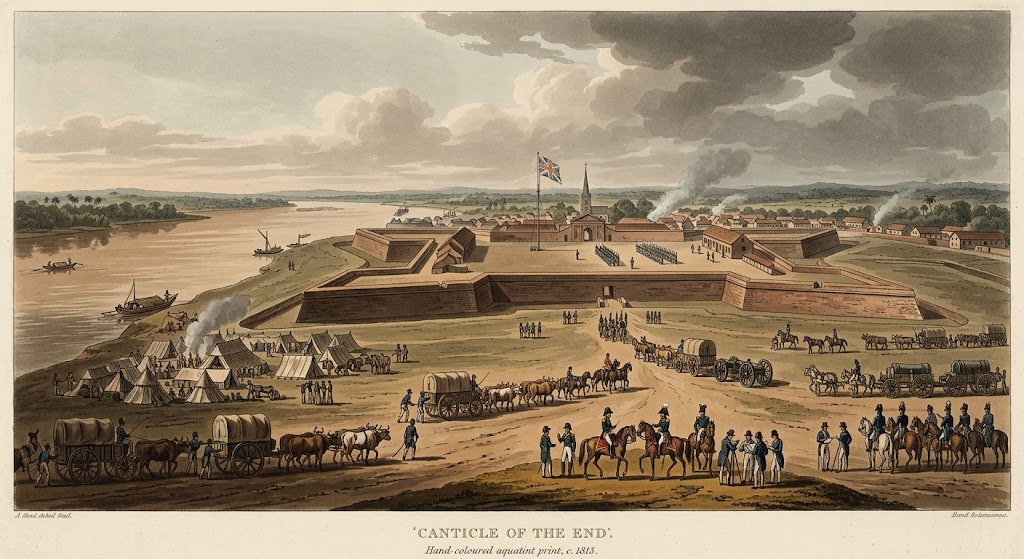
At Fort William, Pratap Singh made his case to Captain Hector Dunmore, a genial, red-faced officer with good whiskers and a new coat he hadn’t paid for. The captain noted that the army was preparing for an invasion of Nepal and could barely spare anyone, but he was persuaded — on the condition that Pratap secure him a dinner invitation to the Cavendish compound to meet the eligible Wentworth sisters. Two sepoys were assigned: Ram Adhin Tiwari, a forty-year-old Brahmin with twenty years of service and a gray mustache, and Ghulam Rasul, a quick and cheerful twenty-two-year-old Muslim from Bihar who was the regiment’s finest marksman.
In Maniktala, Katherine, Elizabeth, and Adrien arrived at Ram Mohan Roy’s garden house to find a lively debate in full swing among a dozen voices arguing politics and religion in two languages at once. Roy himself was a broad-shouldered, charismatic man with a jaw that could crack rocks and dark, piercing eyes, and he dismissed his guests the moment he heard why the investigators had come. He spoke plainly and without hesitation. In 1811, he had written a letter to the Gazette that was set in type and then killed after Hawthorne Surlish paid a pleasant visit to the editor and mentioned, just once, how much advertising the merchant consortium placed in the paper. Since then, Roy had watched Surlish appear in the background of every suppression — on the vestry at St. John’s, on the subscription list paying the Baranagar temple, always present in the room when a clerk mislaid a petition or a magistrate dismissed a complaint.
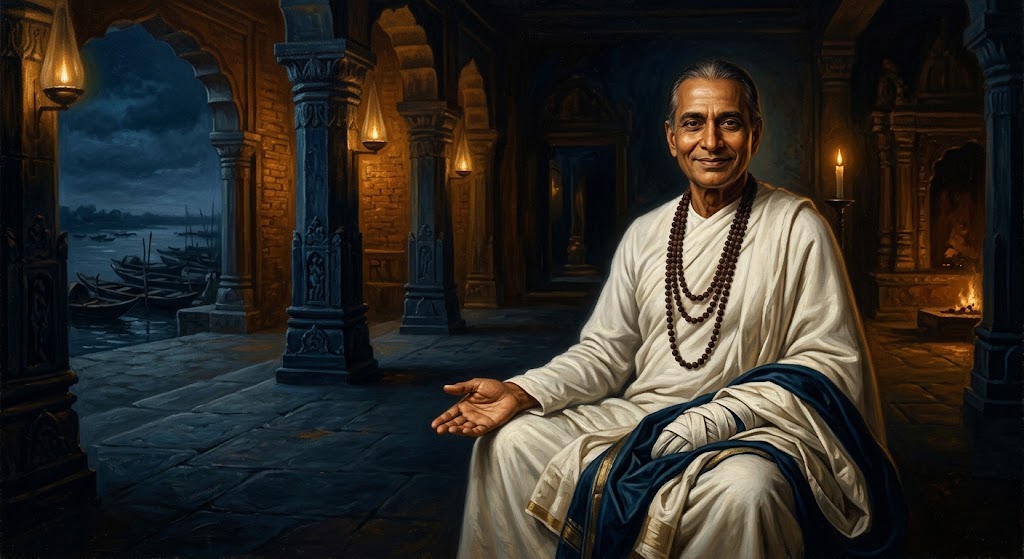
Roy described what had happened to the men who went to the temple at Baranagar for the priest Ghosh’s blessing. They came home soft at first — their hands changed, their manner changed — and then they did not come home at all. The priests told their mothers the men had reached samapti, completion, and gave each family forty rupees. One of Roy’s circle, Bimal, had drawn a man whose arm had no bones in it, and the man had been alive and smiling when the drawing was made. Roy had counted thirty soldiers dead or missing near Baranagar since 1812: eleven found dead, eight of them with the mark of a cord at the throat, and nineteen missing, most of them listed by the company as deserters. Three cases troubled him most: a soldier whose brother swore the man answering to his name now stood taller than he ever had, an engineer’s sepoy whose boots had come out of the river, and a Havildar whose mother had performed his funeral rites and whose pay had stopped coming home. He mentioned, almost as an afterthought, that an English officer had once asked him about the cord marks on the victims’ throats — and then stopped asking entirely.
Freddy’s visit to Ashworth proved more straightforward. Ashworth received him warmly, listened to the request regarding Renwick’s deployment, and wrote a letter of introduction to Colonel Blackwood at Fort William on the spot. He added a personal postscript expressing that he himself would be sorry to lose Renwick from the Baranagar embankment works, a small but meaningful addition that gave the letter considerably more weight. As Freddy rose to leave, Ashworth asked, with genuine curiosity, why a Cavendish cared so much about a Royal Engineer — a question that hung in the air as Freddy referenced his appointment to the East India auditing position and took his leave.
That evening, as the party gathered again at the compound, the full weight of what they had learned began to settle. Surlish was not merely a rude and ambitious merchant — he was the visible hand of a conspiracy that reached into the church, the courts, the press, and the military. The temple at Baranagar was doing something to people, something physical and irreversible, and the men who emerged from it were walking into rivers and murmuring about the end of things. Sophia Surlish had dropped a glove containing a secret note, and Freddy had pocketed it without the party ever finding the note. An English officer had asked the right questions and gone silent. And somewhere in the city, the bodies of the recently dead were being pulled from their graves in the night, their shrouds folded neatly behind them, as though someone wanted them fresh.