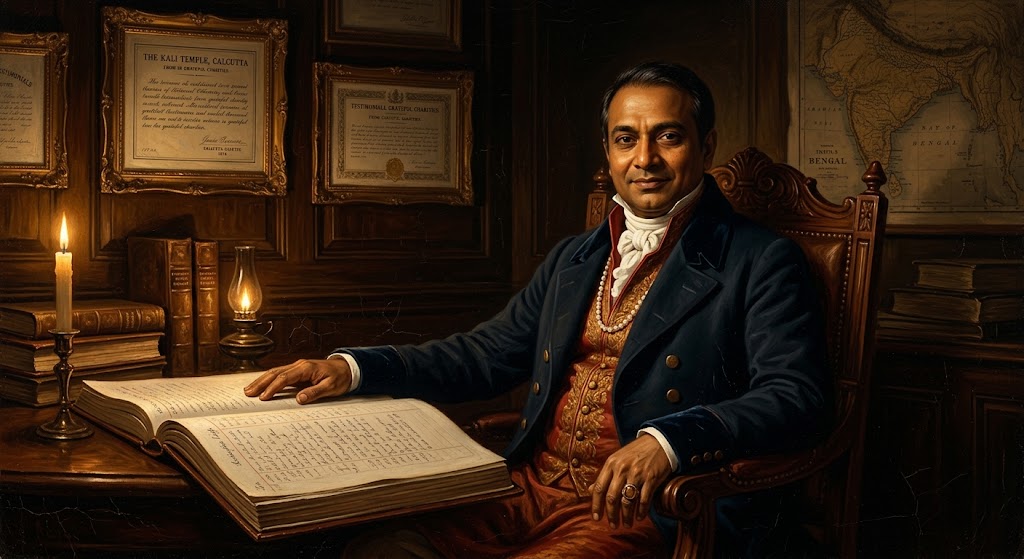
Description
Wealthy Hindu merchant of the banian class, the Indian brokers who interface between European commerce and Indian markets. Courteous, shrewd, immaculately dressed in a blend of Indian and European fashion. Speaks perfect English with Bengali cadence. Generous in a way that creates networks of obligation. His firm handles warehousing, river transport, and export brokerage. He sits on charitable boards alongside British officials.
He is not a bad man. He is a community pillar doing what community pillars do: maintaining temples, supporting institutions, protecting commercial relationships.
Background
One of Calcutta’s most respected Indian merchants. His connection to the Mandir Mahakali is straightforward religious patronage. Ghosh is a respected acharya, and prosperous Hindu merchants support their temples. Mullick has donated for years, attended festivals, and maintained the kind of relationship with the temple that any devout man of means would maintain.
Motivations
Community standing. Religious devotion. Commercial success. Mullick is motivated by the same things that motivate any prosperous, devout merchant: reputation, obligation, faith. The complication is that his faith, his generosity, and his civic instincts have all been weaponised by a man he trusts.
What Makes Him Complicated
Connections
- Charles Ashworth — Personal friend, fellow pillar of Calcutta society
- Hawthorne Surlish — Commercial partner, uses his warehouse facilities
- Hugh Cavendish — Buys opium through Hugh’s EIC network
- Acharya Devendra Ghosh — Religious patron, genuinely reveres Ghosh
- Mandir Mahakali — Years of sincere temple donations
In Play
Chapter 4, Session 9 (9 October 1814) — present, and entirely unseen. He attended Ashworth’s dinner at Garden Reach and the party never registered him. What they did register was his carriage among the others waiting outside: the one drawn by zebras. Nobody asked whose it was.
The zebras are the whole man in one image. A banian of the first rank can afford a spectacle no European in Bengal can match, and he uses it, and the people who matter already know exactly whose carriage that is. See Ashworth Dinner Garden Reach.
Appearances
Ashworth’s welcome dinner (Day 2, as a respected Indian guest), merchant meetings (where Emma encounters him), the ball at Government House (as one of the few Indians invited).
Relationships
- Located at Calcutta 1814 — Resident in Calcutta
- Friend of Charles Ashworth — Ashworth considers him a friend. Mullick considers Ashworth a friend. Both are correct. Neither knows what that friendship conceals.
- Trades with Hawthorne Surlish — Uses Surlish's warehouse facilities. Commercial interdependence.
- Trades with Hugh Cavendish — Buys Hugh's opium for resale through his brokerage network.
- Finances Acharya Devendra Ghosh — Donates generously to the Mandir Mahakali. Genuinely devout. Has no knowledge of the cult's true activities.
- Finances Mandir Mahakali — Years of religious giving to the temple. Legitimate, sincere, and exploited.
- Enemy of Ram Mohan Roy — Mullick's merchant consortium pressured printers to suppress Roy's publications about Baranagar.
- Finances Mandir Mahakali — Wealthy Hindu merchant donates generously, unknowing of the cult's true purpose