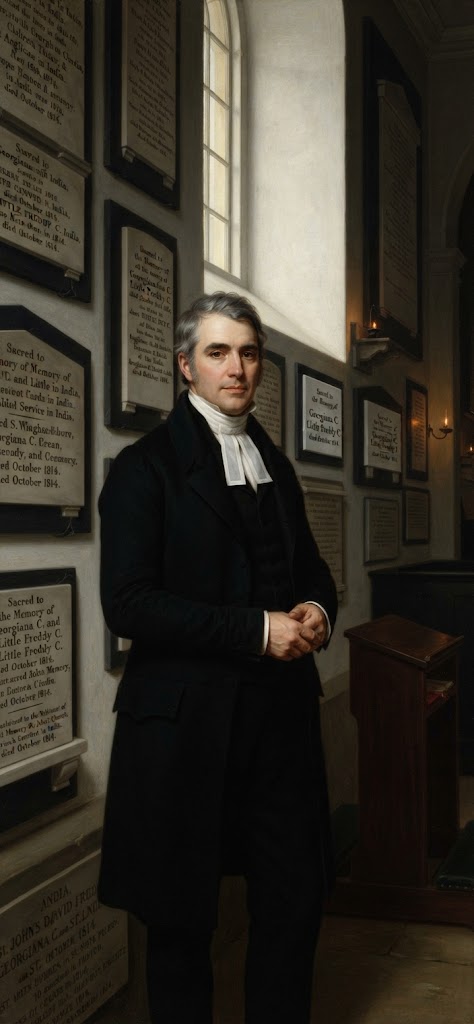
Description
A man who stayed. After his wife Eleanor died of fever in 1809, everyone expected him to go home. He did not. Fourteen years in India, arrived 1800, served in Madras before transferring to Bengal in 1806. Widower. Two children born, two buried in the churchyard, their memorials on the north wall.
Warm but contained. Speaks softly, listens carefully, never appears to rush. His handshake lasts exactly the right length. His sermons are ten minutes shorter than anyone expects, which has made him genuinely popular. He remembers names, children’s names, servants’ names. He learned enough Bengali to hear a dying sepoy’s last words, and this act earned him the permanent respect of the garrison.
He does not drink excessively but accepts every glass offered, because refusing makes people guard their words. He has a dry, quiet humour that surfaces unexpectedly, a single line that makes the whole table laugh, then silence again. The men trust him because he does not judge. The women trust him because he sees them.
Background
Fourteen years of baptisms, marriages, funerals, sermons, pastoral visits, committee meetings, and the steady accumulation of other people’s secrets. He knows more about British Calcutta than anyone except the Courtneys, and unlike the Courtneys, people tell him things on purpose.
The grief of losing Eleanor hollowed a space he filled with work. Pastoral care became his entire identity. Every Sunday, every deathbed, every marriage, every christening. He is the fixed point of British Calcutta’s spiritual life.
The Bishop
Parliament put a bishop into the Company’s charter last year, and the bishop is now at sea. Dr Thomas Fanshawe Middleton, consecrated at Lambeth in May with so little ceremony that the sermon was never printed, sailed in June and is expected at Calcutta before Advent. His see is all of British India. His cathedral, because there is no other candidate, will be St John’s. Jessop has kept sole spiritual charge of Bengal for eight years, answerable to nobody nearer than London, and that arrangement now has about six weeks to live.
Asked about it in company, and he is asked at every table he sits at, he says the Church in India has wanted a shepherd for fifty years and he is glad to have lived to see one sent. He says it warmly, he means it, and the voice he says it in closes the subject. If pressed he offers one dry observation: the settlement has discovered a sudden passionate interest in ecclesiastical precedence, and the Government House aides have been arguing for a fortnight about where a Lord Bishop sits relative to a Chief Justice. What society actually wants to know, and asks him sideways, is whether the bishop means missionaries, because the charter’s pious clause frightens Calcutta far more than any bishop does and Vellore is still inside living memory. Jessop answers that question carefully, every time.
What He Has Noticed
About Sophia: The smile that starts a beat late. The flinch when Surlish touches her shoulder, disguised as adjusting her shawl. He has sat with her twice in private. Once after a difficult evening, once when she came to the church alone on a Tuesday morning and sat in an empty pew for an hour. He did not ask. She did not speak. He brought her water and sat three pews behind.
About Baranagar: Visited Ghosh’s temple two years ago on a pastoral round. Ghosh received him with perfect courtesy, showed him the outer temple, served tea. Jessop left feeling he had been managed. Something about the acoustics of the inner courtyard unsettled him, a quality to the stone that made his chest hum. He mentioned it to nobody because he could not explain it and because it sounded foolish.
About the dead sepoys: He has buried seven soldiers from the Fort William garrison in two years. Varied causes: fever, drowning, “misadventure.” He does not keep a list. But if someone asked him to remember the names, he could. And he would notice they cluster around certain months, the months when Ghosh holds preparatory rituals.
Motivations
Pastoral duty. The accumulated weight of fourteen years of service. He stays because leaving would mean the deaths and the work were for nothing. He stays because someone has to bury the dead and comfort the living and remember the names.
What He Offers
- Introductions on Day 2, publicly at the Sunday service
- Social intelligence through oblique observation, not direct revelation
- Pastoral confidence if an investigator approaches in genuine distress
- The Baranagar observation (the acoustic unsettlement), only if directly asked about the temple
- Burial records that corroborate dead sepoy patterns, if someone thinks to ask
What He Will Not Do
- Betray Sophia’s confidence. If asked directly: “Mrs Surlish is a woman of considerable strength.” No more.
- Take action. He will not join the climax, spy on Kaunitz, or confront Ashworth. He prays and he listens.
- Lie. If the investigators tell him something horrible, he believes them. He has buried too many strange deaths to dismiss the uncanny.
The Sermon on Day 16
If the investigators attend the third Sunday service (two days before Kali Puja), Jessop preaches on Ephesians 6:12: “For we wrestle not against flesh and blood, but against principalities, against powers, against the rulers of the darkness of this world.”
He chose it weeks ago for Advent preparation. He has no idea how precisely it applies.
Connections
In Play
Chapter 4, Session 8 (9 October 1814). Read the newcomers from the chancel at Sunday service, exactly as Meg had warned: the Wentworth sisters, Frederick Cavendish, Katherine Ward, and the Vicomte Adrien de Montferrand — a Frenchman. Every head in the congregation turned. See St Johns Presentation.
No conversation was had with him. He has, in one morning and without meeting them, put every cover in the party onto the public record of a city that catalogues everyone.
Chapter 4, Session 9 (9 October 1814) — the sermon, and a quiet welcome. He delivered the morning service at St John’s and, during the churchyard hour, offered the newcomers spiritual guidance and said he looked forward to seeing them at the Magistrate’s dinner. He went in to dinner at Garden Reach on Patience Wright’s arm.
What he has heard at Baranagar has not come up. He has noticed the acoustics and has chosen not to raise them. Still available.
Appearances
Church services (every Sunday), social events throughout the chapter, pastoral visits, the mess dinner, the ball.
Relationships
- Knows Sophia Surlish — Has watched her composure erode over three years. Will not betray her confidence.
- Located at Mandir Mahakali — Visited two years ago. Something about the inner courtyard acoustics unsettled him. Mentioned it to nobody.