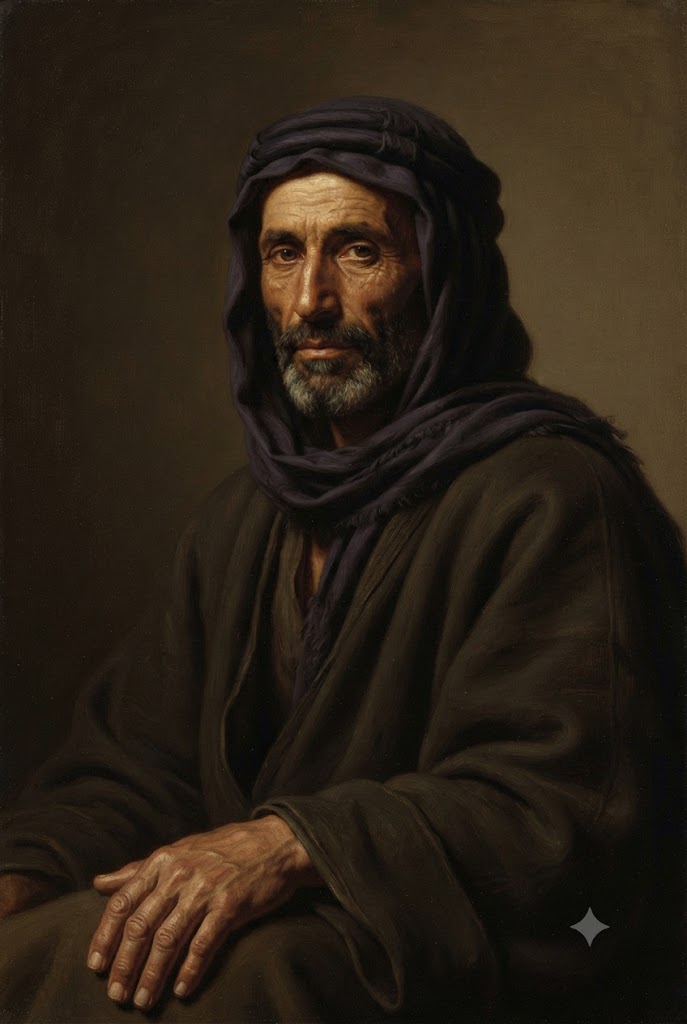
Description
Bedouin, fifties, lean as wire, born in the Eastern Desert and unimpressed by it. He navigates by the shape of specific rocks and has never once explained this to anybody. He walks the camel line before a departure touching loads and saying nothing, and at the end of it he looks east at a sky that has not started yet, and then the caravan moves.
He regards his travellers the way a shepherd regards sheep: valuable, stupid, and in constant danger of dying. This is not unkindness. It is not kindness either. It is an accurate professional assessment refreshed daily, and it is why everyone who hires him arrives.
He travels with four men. Two armed escorts, Bedouin, younger, carrying jezails and curved daggers. Two camel drivers, Egyptian, one old and one very young. The old one knows every well between here and the Red Sea. The young one is his nephew and is learning the trade, and he is shy of Europeans and will not volunteer a word to one.
Background
The road is his. Not owned, exactly, but his in the way a stretch of water belongs to a pilot who has never lost a hull on it. Cairo to Suez, 84 miles, two to three days, twenty to thirty camels, a few donkeys, and one or two carriages for Europeans who will not ride. Armed escort as standard, because the route requires it and always has.
He has been doing this long enough to have opinions about every kind of traveller there is, and he keeps every one of them to himself.
Motivations
He wants his caravan on the road, his water rationed correctly, and his people alive at Suez. That is the entire list, and it is not negotiable, and it does not expand to accommodate anybody’s crisis.
He will not investigate a murder. He will keep order, because order is his road and his job. He will answer questions honestly if asked. He has noticed things he does not consider relevant, and he will not mention them until somebody asks the right question, because in his view it is not his business what Europeans do to each other.
Connections
- Wadi al Tih — the midpoint halt.
- Abu Yusef — the keeper. Twenty years of the same road.
- Gerald Hewitt — called him “boy,” once.
- Yusuf — the Cairo dragoman who brokers the party’s passage.
Appearances
Session Appearances
Session 5 (Cairo, 16–20 Sept 1814): His caravan is now engaged by the party for the Cairo→Suez crossing departing the morning of 20 September, booked through Krikor Bedrossian. The party has not yet met him in person — they join his caravan on the road.
Outcome (Session 6)
He kept order on the road and kept it after the killing. When Hewitt called him “boy” on the crossing, he answered not with the flat silence the prep expected but with a private word, whatever it was, that left Hewitt white-faced and stammering apologies to everyone in earshot. What he said stays his own. After the body was found he examined the lock, confirmed the key had been on the inside, and then refused any part of the investigation, wanting only the buried gate dug clear and his caravan moving again. When the storm lifted he got them back on the road toward Suez, leaving the wadi and its dead Englishman behind in the settling dust.
Outcome (Session 7) — Suez
He brought the caravan over the last gravel ridge, halted it at the edge of Suez, collected his money, and parted ways without ceremony — no lingering business, no reference to the dead Englishman, nothing owed in either direction. He offered the party a place at the wakala if they failed to find other lodgings; they took the Company houses instead.
His contract is discharged and the road behind the party is closed. He is west of them now, and the campaign has no further use for him unless it ever comes back this way.
Relationships
- Located at Wadi al Tih — Halts here at the midpoint of every Suez crossing he runs
- Knows Abu Yusef — Twenty years of the same road and the same halt. Professional, unsentimental, entirely mutual.
- Enemy of Gerald Hewitt — Hewitt called him 'boy' once, on the road, in front of everyone
- Parent of Tariq — Hassan's nephew, taken on to learn the trade. Hassan says little to him and everything by example.