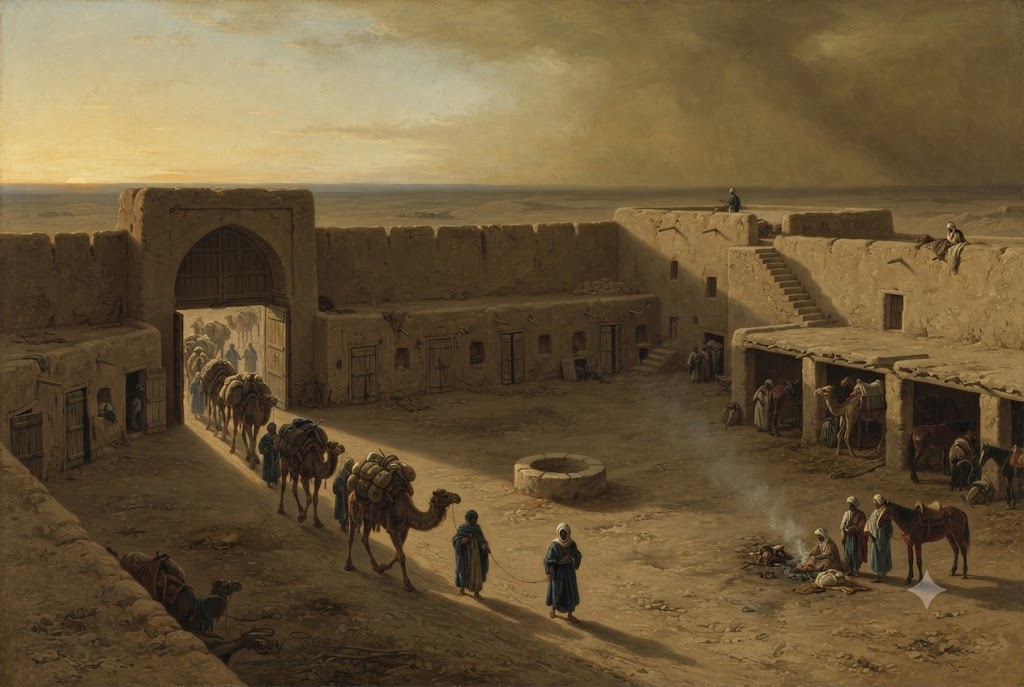
Description
Roughly the midpoint of the Suez overland crossing. The canal does not exist and will not for another fifty years, so the road from Cairo to the Red Sea is 84 miles of gravel desert, two to three days by caravan, ancient, well-established, and dangerous enough that the passage comes with an armed escort as a matter of course rather than as a precaution.
The caravanserai is mud-brick walls ten feet high around a central courtyard with a well in it. The water is brackish and drinkable, in that order. Rooms run around the perimeter as stone-floored alcoves, each with a wooden door, a rope bed, a hook for a lantern, and a shutter window that actually shuts. There is a larger common room, stables, and a flat roof reached by an exterior stairway.
It is not a hotel and does not pretend to be. It is a box with a wall around it, standing where it stands because a caravan can only go so far in a day, and it has been standing there long enough that Abu Yusef has run it for twenty years and does not consider that a long time.
Notable Features
- The wall — mud brick, ten feet, and the only thing between the courtyard and the desert.
- The well — brackish, drinkable, and the reason the building exists.
- The rooms — stone-floored alcoves. Wooden doors with iron locks, and a gap under each door wide enough to matter. Shutter windows that genuinely lock from the inside.
- The common room — where the evening fire is, and where the tea gets poured.
- The flat roof — exterior stairway, no rail.
- The gate — which the sand buries.
The Sandstorm
It announces itself the evening before. The sky to the south goes brown-yellow and Hassan quietly tells his men to bring the camels inside without explaining anything to anybody, least of all the Europeans.
Overnight the wind rises and does not stop. Sand hisses along the outside of the wall in long rising and falling pulls and finds every gap under every door. By dawn the gate is buried, visibility is roughly the length of an arm, and sound is muffled and directionless. The wind makes a sustained noise that has pitch to it.
Nobody goes anywhere until it lifts, and when it lifts, the caravan moves, because the water is rationed and Hassan will not hold his people at a dry halt.
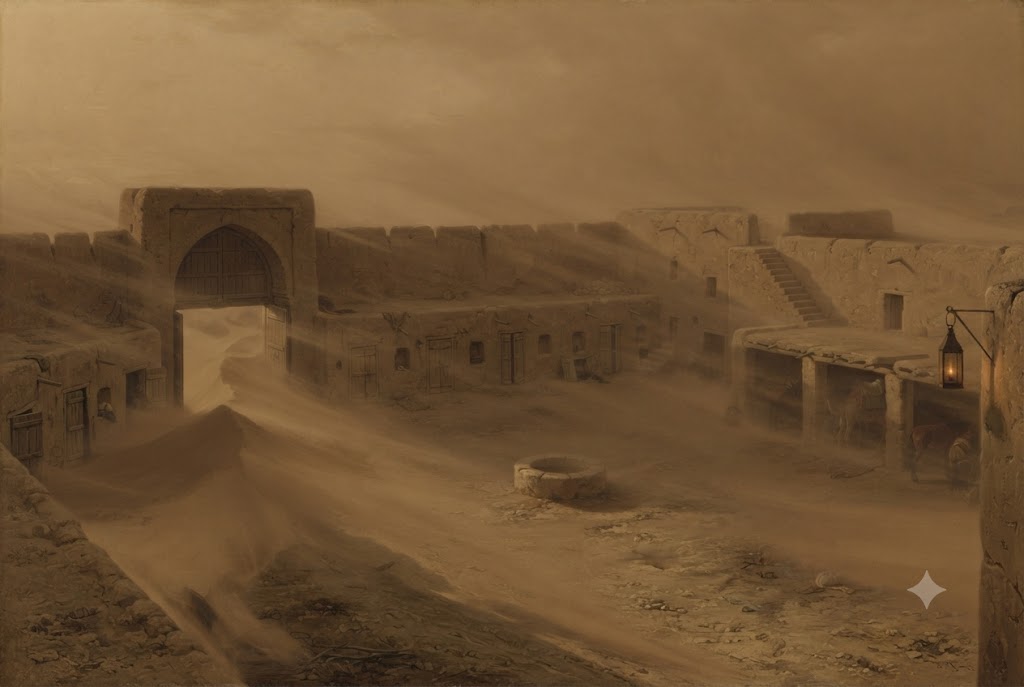
What Happened Here (Session 6)
Played on the crossing of ~21–24 September 1814. The sandstorm sealed the gate exactly as designed, closing the suspect pool, and Gerald Hewitt was murdered here in his alcove by Elizabeth Ashby. The investigators broke the locked-room contrivance and heard her confession, then released her; Rajan was cleared and left in Abu Yusef’s care, his keep paid by Freddy. When the storm lifted the caravan dug out and moved on toward Suez. Full record: Wadi al Tih Murder and Chapter 04 Session 06 Wrap Up.
Connections
- Cairo — 84 miles west. The road’s origin, and where the passage is brokered through Yusuf.
- Abu Yusef — keeper, twenty years.
- Hassan al-Rashidi — caravan master. Keeps order, will not investigate.
- Gerald Hewitt — dies here.
- The Desert Caravanserai — the full adventure design.
- The Island Stop — what comes after Suez.
Appearances
Relationships
- Borders Cairo — Roughly the midpoint of the 84-mile overland road east out of Cairo toward Suez
- Part of Egypt — Caravanserai roughly midway on the Cairo–Suez desert road