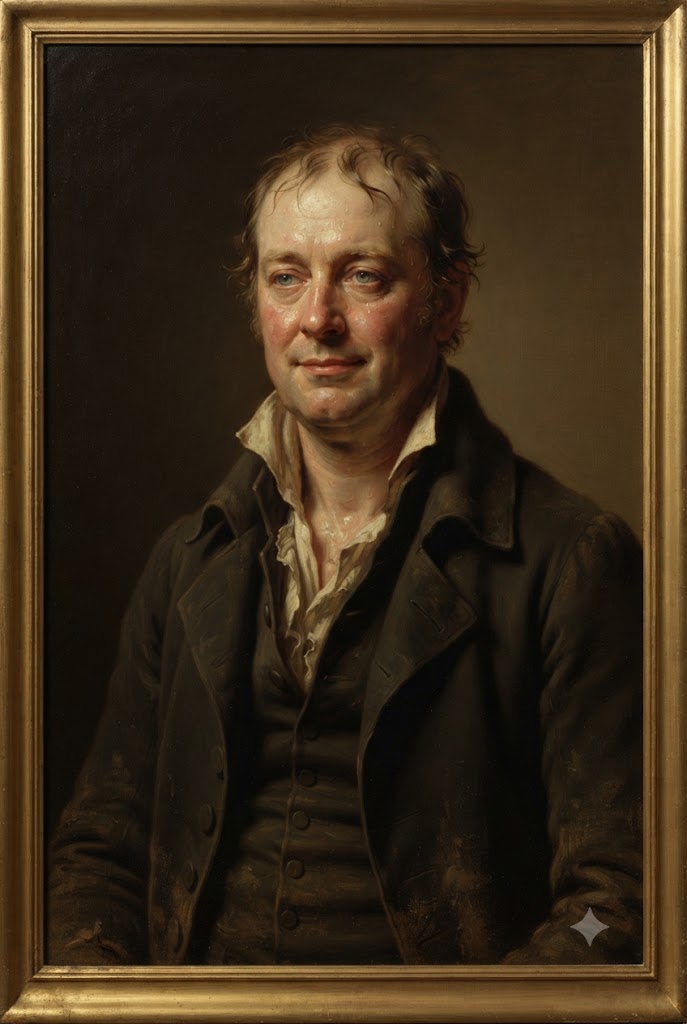
Description
Florid, loud, and sweating from the moment the sun comes up. Mid-forties, going soft, an East India Company factor heading back to Calcutta after however long in England was long enough. He speaks to servants badly, addresses Europeans with a forced bonhomie that assumes agreement it has not earned, and complains without pause about the heat, the coffee, the camels, the road, the Company, and the general decline of everything.
He is not a villain. Nothing so interesting. He is a middling man with a small amount of institutional power who has spent twenty years discovering that nobody will ever make him stop, and the discovery has finished him.
Background
Twenty-odd years in the Company’s service in Bengal. He has done well enough, in the specific way the Company rewards: he has crushed the people it was profitable to crush and been pleasant to the people it was necessary to be pleasant to, and he has never once been asked to account for any of it.
He tells stories about India constantly. The stories reveal casual atrocities framed as adventures, and the horror of them is not that he is boasting. He genuinely does not know they are atrocities. They are simply what happened, and they were funny at the time, and he cannot understand why the table has gone quiet.
Motivations
To get back to Calcutta, where he is somebody, and where the machine he is part of will keep on being the machine. He wants an audience on the road and he will take one wherever he finds it.
Connections
- Rajan — his servant. The abuse is constant, public, and entirely one-directional.
- Abu Yusef — the caravanserai keeper, who recognises him at the gate.
- James Pelham — destroyed his mentor’s career and told him so.
- Luca Mancini — owes Hewitt a trivial debt from Bombay years ago.
- Elizabeth Ashby — a pleasant woman travelling alone who asks him thoughtful questions.
- Hassan al Rashidi — called him “boy.”
- Freddy Cavendish — his preferred audience on the road.
Session Appearances
Session 5 (Cairo, 17 September 1814) — met before the corpse. Hewitt was the European who buttonholed Freddy in the Greek tavern by the Frank Quarter gate, introducing himself as “Ben” — six days stranded waiting for camels, and instantly alert to Freddy’s Board of Control connection, which he worked into a rolling complaint about East India Company policy. The Keeper confirmed this “Ben” is Hewitt (2026-07-18). This satisfies the load-bearing requirement for the caravanserai mystery: the victim is met, and disliked, before he is a corpse, and Freddy is the investigator the other travellers watched him condescend to.
Session 6 (the road and Wadi al Tih, 20–22 September 1814) — earns it, then dies. Two days on the Suez road spent exactly as designed: he spat contempt at everyone, beat Rajan, lectured Freddy with confident wrong advice about Calcutta, and called Hassan “boy” until a private word from the caravan master left him white-faced. Nathaniel Holt struck him over the beating. On the storm-bound night at the caravanserai, Elizabeth Ashby drugged his evening tea with opium and strangled him with a silk cord in his alcove, staging the door to look locked from within. Found dead the next morning, purple-faced and ligature-marked. Dead. The party solved it and let his killer travel on.
His road-lectures to Freddy — on health, fortune, servants, and the management of an empire — were preserved almost word for word: see The Wisdom of Mr Gerald Hewitt.
Appearances
Relationships
- Located at Wadi al Tih — Murdered here, in a room made to look locked from the inside (night of 21–22 September 1814)
- Employs Rajan — His servant, and the person he abuses most reliably and most publicly
- Enemy of Abu Yusef — Forced him to hand over the caravanserai's emergency water. Two people in the next group died.
- Enemy of James Pelham — Destroyed the career of Pelham's mentor
- Enemy of Hassan al Rashidi — Called him 'boy' once, on the road, in front of everyone
- Caused Silas Ashby — Hewitt took a kickback and cut him out of the trade c. 1799; the reason for everything that follows