Description
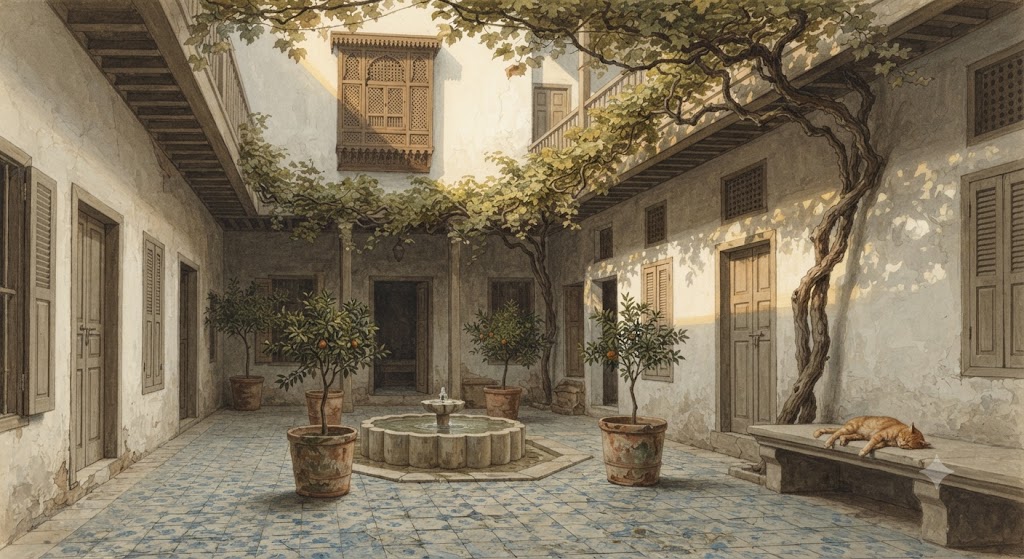
A secure, whitewashed inn three streets into the Muski, behind a blue door in an otherwise anonymous wall — the party’s standing base in Cairo. Inside, a tiled courtyard in worn blue-and-white holds a running fountain (fed by a bribed conduit), a vine older than the marriage of its proprietors climbing the south wall, and a scatter of orange tubs. Presiding over all of it from a stone bench is Le Corporal, an enormous one-eyed cat who, by universal table agreement, outranks the guests.
The inn is run by Sergeant Bruyère, a one-eared former French gunner of the Armée d’Orient who missed the evacuation on purpose and stayed in Egypt by choice, and his wife Sitt Nafisa, a broad, upright Cairene woman who is the true power behind the establishment and who, by the table’s own description, cooks as an act of aggression. The building itself is Nafisa’s inheritance — her grandfather’s merchant house — with a deliberate dual legal identity: a Frank name for matters of silver and trade, a Cairene deed for the tax-farmers. Bruyère married into it and now runs its order and security; she runs its economy and its standing in the neighbourhood.
After a ship’s cabin, a coastal djerm, and a dahabeah’s cramped cabin, the Auberge offers what none of them could: a fountain running in a tiled courtyard, a shuttered window, and a door that shuts on quiet.
Notable Features
- The blue door — the only mark on an otherwise whitewashed, anonymous wall; the inn does not advertise itself.
- The courtyard — worn blue-white tile, the bribed-conduit fountain, the ancient vine over the south wall, orange tubs, and Le Corporal’s bench.
- Six gallery rooms, arranged around the courtyard:
- A corner room with a mashrabiya screen overlooking the Muski — unseen watching, a natural fit for Katherine.
- Two quiet garden doubles, facing the courtyard.
- Two loud street rooms — Thomas’s and Holt’s.
- An end room with a window onto the roof stair — rooftop egress that bypasses the courtyard entirely (Nafisa mentioned this to Katherine within the hour of arrival).
- Iron locks throughout, and Bruyère’s master key worn visibly on a heavy iron chain — a statement of control as much as convenience.
- The strong-room — an old grain cellar behind an iron door. Bruyère sleeps in the room above it with an oiled dragoon’s pistol close to hand.
- The kitchen — pigeon with green wheat, lamb with apricot, lentils and rice, coffee that never seems to stop coming. French wine and brandy are kept upstairs in the salon, door shut; the price of the brandy is French war-talk, and Adrien drinks free there for life. Full meal service, and what the kitchen refuses, is set out under The Table below.
- The roof terrace — the Citadel one way, the Giza haze the other. Marked at the table as Katherine’s spot.
- Nearby services, brokered through the inn: a discreet ex-Armée d’Orient médecin (Dr. Chastain — gout, beautiful hands, absolute discretion) two streets off for quiet medical needs; laundry with orange-water; a gallery barber; neutral mail through both consulates; the hammam (see Washing below, which is where guests actually get clean, since the inn has no bath).
- The rooms and the washing arrangements are set out under The Rooms and Washing below. Rope beds, mosquito nets, shutters and no glass, a brass basin and ewer, and a zir jar in the courtyard shade for drinking water.
- The Giza excursion (offered, not yet taken) — Bruyère runs it as a quartermaster’s set piece: donkeys to the Old Cairo ferry, fresh mounts on the far bank, water, cold fowl, and carpets, with a dawn start (“at noon the Pyramids belong to the flies”). Tariff: 30 piastres per head per day, prix fixe chalked bilingual, no haggling. This has been offered and priced but had not been undertaken as of the end of Session 4 — the party had only just arrived and settled in.
The Rooms
Six of them, off the gallery, around the courtyard. They are clean, and that is the strongest claim anyone makes for them.
Whitewash, redone often enough that it flakes when a trunk goes against it. Rush matting wall to wall, and a worn carpet over it in the better rooms. No glass anywhere in the building: the windows are wooden shutters, louvred, and they are either open to the noise or closed against it and there is nothing in between. Pegs on the wall instead of a wardrobe, because a wardrobe is furniture for people who are staying. A wooden chest with a bad lock at the foot of each bed, which is exactly why Bruyère’s strong-room exists and why he mentions it on arrival. A low table. One stool. An oil lamp and a tin of matches.
The beds are wooden frames strung with rope, with a cotton mattress over the rope and a cotton sheet over the mattress. Bruyère’s one concession to Frank expectation is that they are raised off the floor at all, because his wife’s family would put a mattress down on the matting and think nothing of it. They are firm in the way a rope bed is firm, they creak, and after five days on a dahabeah and six weeks in La Speranza’s after cabin they are going to feel like the finest furniture in Christendom.
Every bed has a mosquito net. This is not decoration and it is not optional, and Nafisa will check that they are down. The net is the difference between a night’s sleep and dawn spent counting bites.
The rooms have livestock. Fleas certainly, bedbugs probably, and the whitewash gets redone as often as it does for a reason. Nobody at the Auberge considers this a defect and nobody in 1814 would. It is worth exactly one line on the first night and never mentioning again.
Washing
The party came in off the river of an evening after weeks on boats, and this is the first thing they will ask about. There is no bath in this building. There is no tub, no tin hip bath, nothing to sit down in. Bruyère is French but the house is Cairene and the Cairene answer to a dirty Frank is not a tub, it is the hammam.
In the room: a brass basin and a brass ewer. You pour, or somebody pours for you, and the water goes over your hands and face and into the basin and that is a wash. Washing means water moving over you. Sitting in your own dirty water is an idea that would strike this household as genuinely revolting and any local would rather not think about it. A guest who demands a tub will get an answer that is polite and will not get a tub.
The water: Nile water, carried up from the river on a man’s back in a goatskin, because that is where all of Cairo’s water comes from and there is no other supply. It arrives the colour of weak tea and full of silt. It goes into a zir, the big porous earthenware jar standing in the shade of the courtyard, and it sits until the silt drops out and the jar sweats itself cool. Drinking water comes off the top of that, and it is better than anything they have had since Alexandria. The courtyard fountain is fed by a bribed conduit and it is for the courtyard, not for the guests, and washing in it is the kind of thing you only do once.
For actually getting clean: the hammam, brokered through the inn like the barber and the laundry and the médecin. Separate hours for men and women, never both. Steam, a scrubbing from a stranger with a coarse mitt that removes a layer of the Nile the party did not know they were wearing, and an hour of lying on hot marble afterwards. Katherine, Emma, and Georgiana have done this before, at the baths in Alexandria, and know the drill. The men have not. That asymmetry is free comedy and a genuinely good scene, and it costs nothing.
The Table
The party came through the blue door on the first day of Eid al-Fitr, at the close of thirty days in which Sitt Nafisa took neither food nor water between dawn and sunset. That timing is worth sitting with. She has been baking since the last week of Ramadan, fasting, arms floured to the elbow, unable to taste a thing she made. The results are stacked in the pantry in tins and on trays under cloth, and now the fast is broken and all of it comes out at once. This is not hospitality. This is a month of held breath being let go, and the guests have walked into the middle of it with their timing entirely accidental.
The feast runs three days, 16 to 18 September. After that the kitchen settles into its ordinary rhythm, which is still more food than any of them want.
Breakfast
Offered, laid out rather than cooked, and on the courtyard table from first light.
Ful medames, which is fava beans stewed all night in a narrow-necked copper pot banked in the ashes, served with oil, lemon, and cumin. Baladi bread, torn and never cut. White cheese, hard and salt enough to sting a cracked lip. Olives. Coffee, which does not stop and is not asked for. During Eid there is kahk beside it, and there will be kahk beside it for weeks, because she made hundreds.
What is not offered: eggs to order, bacon, kippers, chops, anything a Frank would recognise as a proper breakfast. Nobody is going to cook a separate English meal at six in the morning and no amount of asking will change that. Bruyère eats his standing, in four minutes, the way a gunner eats.
The midday meal
The real one. The reason to come back to the inn rather than eat in the Muski.
This is where the pigeon with green wheat lands, the birds split and stuffed with freekeh that smells of smoke because the wheat was fired green. Lamb with apricot, slow enough that the meat gives to a spoon. Lentils and rice under fried onion. Mulukhiyya, which is a soup the colour of pond weed and the texture of something alive, and which she watches the English eat with open interest. Bread to move it all. Fruit after, and coffee, always coffee.
During Eid the midday table carries meat at a volume the household cannot afford on an ordinary week, and Nafisa will not discuss the cost.
Evening
Offered, and deliberately lighter. Bread, cheese, olives, cold fowl, whatever the midday meal did not finish, fruit, coffee. It is food to sit over rather than food to eat, and the courtyard at that hour is the point rather than the meal.
Eid suspends this. For three nights the evening table is a second full meal, lamp-lit, and it goes on late.
What the kitchen will not serve
- Pork. Ever. No bacon, no ham, no lard in the pan. The building is a Cairene household and the fact that a Frenchman married into it changes nothing about what comes out of that kitchen. A guest who pushes this will find Bruyère less genial than his manner promised.
- Wine and brandy at the table. Both live upstairs in the salon behind a shut door, and that door is where they stay. Nothing is drunk in the courtyard but coffee and water. The separation is deliberate and it is Nafisa’s, not his.
- Meals to order, at hours that suit the guest. The kitchen serves when it serves. Missing it means bread, cheese, and Nafisa’s opinion of you.
- Nothing at all at dawn on the first day of Eid. The kitchen is cold and the household is out at the prayer.
Session Appearances
Session 5 (Cairo, 16–20 Sept 1814): Confirmed as played — the party’s Cairo base over Eid. Details established in play: a running courtyard fountain, an ancient vine on the south wall, terraced rooftops with a city view, a mashrabiya-screened corner room, an upstairs French salon of Bruyère’s full of shredded months-old French newspapers, an underground strong-room (the old grain cellar behind an iron door), and a stoic one-eyed courtyard cat.
Connections
- Sergeant Bruyère and Sitt Nafisa — proprietors; see their own entity files for full background.
- Frank Quarter — the district the inn sits within, three streets into the Muski.
- The Muski — the market street the party walked inland from Bulaq to reach the inn.
- Cairo — the city.
- Standing base for Holt, Emma, Georgiana, Katherine, Thomas, Adrien, and Freddy from arrival in Cairo onward.
Images
Appearances
Relationships
- Part of Frank Quarter — Three streets into the Muski, within the Frank Quarter proper
- Borders The Muski — Reached inland from the Bulaq landing through the Muski's narrow lanes
- Serves Sergeant Bruyere — Runs the inn's daily order and security; holds the visible master key
- Part of Cairo — Located within the Muski district of Cairo
- Part of Cairo — The party's standing Cairo base, three streets into the Muski
- Part of Frank Quarter — The Auberge sits three streets into the neighbouring Muski, within reach of the Frank Quarter proper
- Part of The Muski — The inn sits three streets into the Muski, off the main lane